
POWER STEERING SYSTEM - TEST
- Make
- Land Rover
- Model
- Range Rover P38
- Section
- FAULT DIAGNOSIS › POWER STEERING SYSTEM - TEST
57
STEERING
NEW RANGE ROVER
6
FAULT DIAGNOSIS
POWER STEERING SYSTEM - TEST
Service repair no - 57.90.10/01
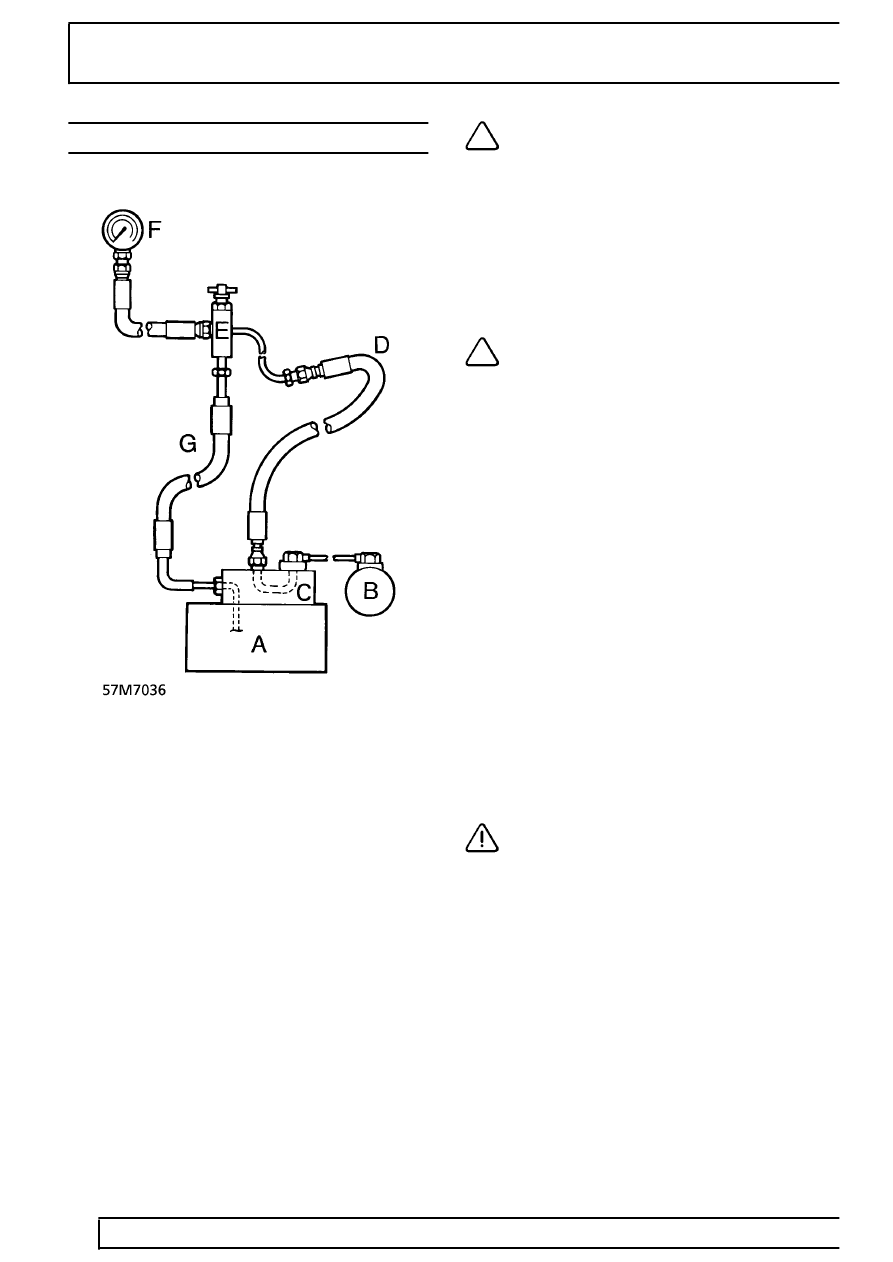
A
Steering box
B
Steering pump
C
Adaptor block LRT-57-031
D
Hose LRT-57-031
E
Test valve LRT-57-001
F
Pressure gauge LRT-57-005
G
Hose LRT-57-030
Test Equipment - Assembly
1. Remove nut securing existing high and low
pressure pipes to steering box A.
2. Remove both banjo bolts from steering box.
Collect sealing washers.
3. Release existing pipes beneath radiator to allow
manipulation at steering box.
4. Connect existing low pressure pipe to steering
box. Secure with banjo bolt.
5. Fit hose D to adaptor block C. Fit assembly to
high pressure port of steering box. Secure with
banjo bolt.
6. Connect existing high pressure pipe to adaptor
block. Secure with banjo bolt.
NOTE: The high pressure pipe and hose D,
could be transposed depending on hand
of drive.
7. Fit hose G to adaptor block C.
8. Connect pressure gauge F to test valve E.
Connect hoses D and G to test valve E.
9. Ensure steering system is free from leaks.
Maintain maximum fluid level during test.
Test Procedure
NOTE: If power steering lacks assistance,
check pressure of hydraulic pump before
fitting new components. Use fault finding
chart to assist tracing faults.
1. A hydraulic pressure gauge and adaptor is used
to test the power steering system.
2. When testing the system, turn the steering wheel
gradually while reading the pressure gauge.
3. With the test valve open start the engine.
4. With the engine at 1500 rev/min, turn the
steering wheel. Hold on full lock.
5. Repeat pressure check in opposite lock.
6. The test pressure should be between
35 and 75 bar (507 and 1090 lbf/in
2
), depending
on the road surface. Pressure will drop back to
between 32 and 48 bar (464 and 696 lbf/in
2
),
when held in full lock.
7. With the engine idling, release the steering
wheel. Pressure should read below 7 bar
(102 lbf/in
2
).
8. Pressures outside the above tolerances indicate
a fault.
9. To determine if the fault is in the steering box or
steering pump. Close the test valve, for a
maximum of five seconds.
CAUTION: Pump damage will occur if test
valve is closed for longer periods.
10. If the gauge does not register between 100 and
110 bar (1450 and 1595 lnf/in
2
) (maximum pump
pressure), the pump is faulty.
11. If maximum pump pressure is correct, suspect
the steering box.
12. On completion, remove the test equipment and,
using new sealing washers, connect pipes to
pump with banjo bolts.
M16 bolts: Tighten to
50 Nm (37 lbf.ft).
M14 bolts: Tighten to
30 Nm (22 lbf.ft).
13. Check fluid level.
See LUBRICANTS, FLUIDS
AND CAPACITIES, Information.
14. Bleed power steering system.
See Repair.
Parts & tools for this job Staging For Land Rover Range Rover
- TOOLTie rod end toolSearch: tie rod end puller
- TOOLBall joint separatorSearch: ball joint separator
- FLUIDPower steering fluidSearch: Land Rover power steering fluid
Links open Amazon search results in a new tab. As an Amazon Associate I earn from qualifying purchases.