
Supplementary restraint system precautions (page 2 of 7)
- Make
- Land Rover
- Model
- Freelander Service Procedures
GENERAL INFORMATION
03-21
It should be noted that these precautions are not
restricted to operations performed when servicing
the SRS system, the same care should be exercised
when working on ancillary systems and components
located in the vicinity of SRS components; these
include but are not limited to:
l
Steering system – steering wheel airbag,
rotary coupler.
l
Front fascia – passenger front airbag (where
fitted); SRS DCU behind centre console, on
transmission tunnel under the HeVAC system.
l
Front seats – seat belt pre-tensioners, integral
with seat belt buckle assembly.
l
Electrical system – SRS harnesses, link leads
and connectors.
Making the SRS system safe
Before working on or in the vicinity of SRS
components, ensure the system is rendered safe by
performing the following procedures:
l
Remove the ignition key from the ignition switch.
l
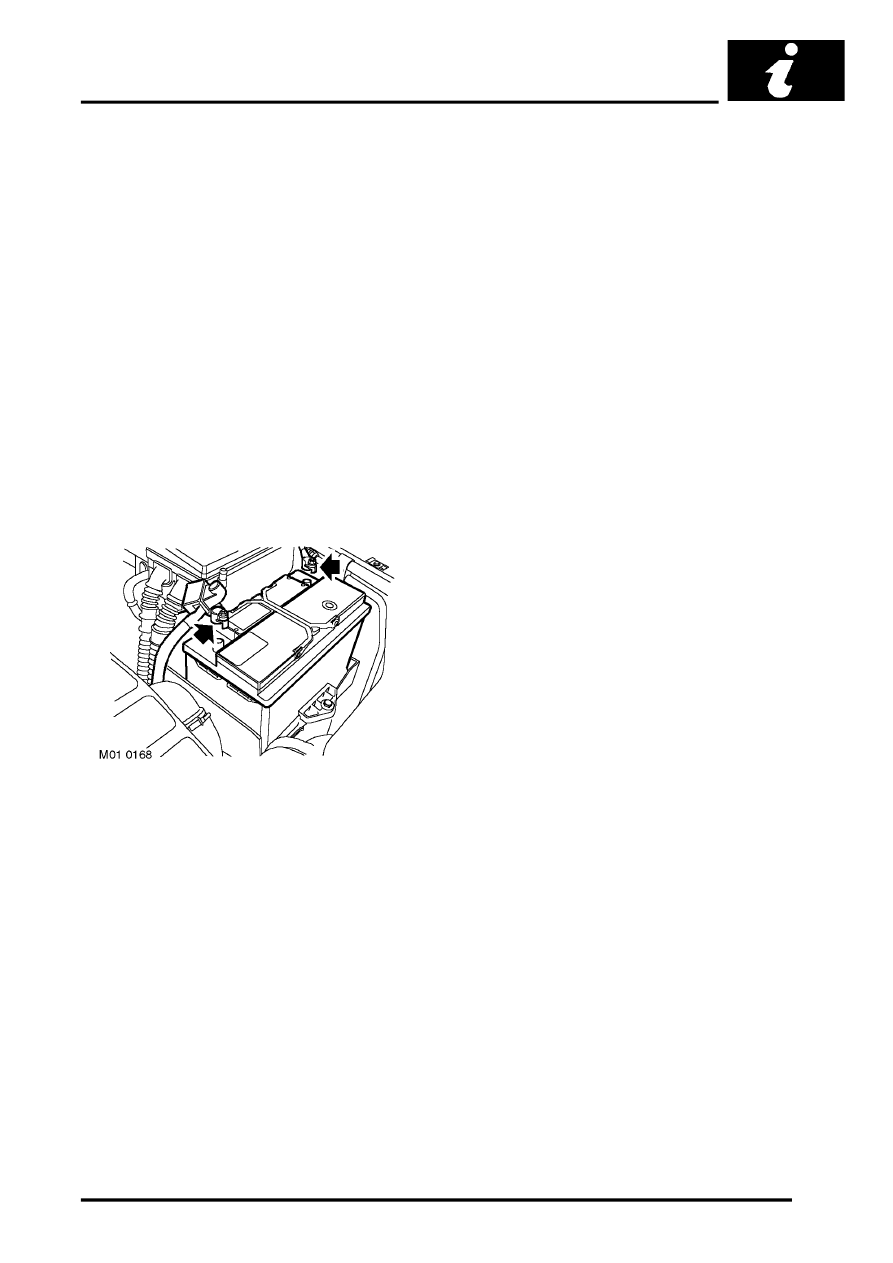
Disconnect both battery leads, earth lead first.
l
Wait 10 minutes for the SRS DCU back-up
power circuit to discharge.
The SRS system uses energy reserve capacitors
that keep the system active in the event of electrical
supply failure under crash conditions. It is necessary
to allow the capacitor sufficient time to discharge (10
minutes) in order to avoid the risk of accidental
deployment.
WARNING: Always disconnect both battery leads
before beginning work on the SRS system.
Disconnect the negative battery lead first. Never
reverse connect the battery.
Installation
In order to assure system integrity, it is essential that
the SRS system is regularly checked and maintained
so that it is ready for effective operation in the event
of a collision. Carefully inspect SRS components
before installation. Do not install a part that shows
signs of being dropped or improperly handled, such
as dents, cracks or deformation.
WARNING: The integrity of SRS system
components is critical for safety reasons. Ensure
the following precautions are always adhered to:
l
Never install used SRS components from
another vehicle or attempt to repair an SRS
component.
l
When repairing an SRS system only use
genuine new parts.
l
Never apply electrical power to an SRS
component unless instructed to do so as
part of an approved test procedure.
l
Special Torx bolts are necessary for
installing the airbag module — do not use
other bolts. Ensure bolts are tightened to the
correct torque.
l
Always use new fixings when replacing an
SRS component.
l
Ensure the SRS Diagnostic Control Unit
(DCU) is always installed correctly. There
must not be any gap between the DCU and
the bracket to which it is mounted. An
incorrectly mounted DCU could cause the
system to malfunction.
CAUTION: Ensure SRS components are not
contaminated with oil, grease, detergent or
water.
Ensure that SRS component fixings are correctly
positioned and torqued during service and repair.
CAUTION: Torque wrenches should be regularly
checked for accuracy to ensure that all fixings
are tightened to the correct torque.
If you suspect an airbag assembly could be
defective, install a new unit and dispose of the old
unit. Manually deploy the old unit before disposal.
Parts & tools for this job Staging For Land Rover Freelander
- TOOLOBD2 scanner with SRSSearch: OBD2 scanner ABS SRS
- TOOLTrim removal tool kitSearch: trim removal tool kit
Links open Amazon search results in a new tab. As an Amazon Associate I earn from qualifying purchases.