
CYLINDER HEAD GASKET (page 5 of 6)
- Make
- Land Rover
- Model
- Range Rover P38
- Section
- REPAIR
12
ENGINE
NEW RANGE ROVER
28
REPAIR
Piston Protrusion - Check
34. Ensure cylinder block face and piston crowns
are clean.
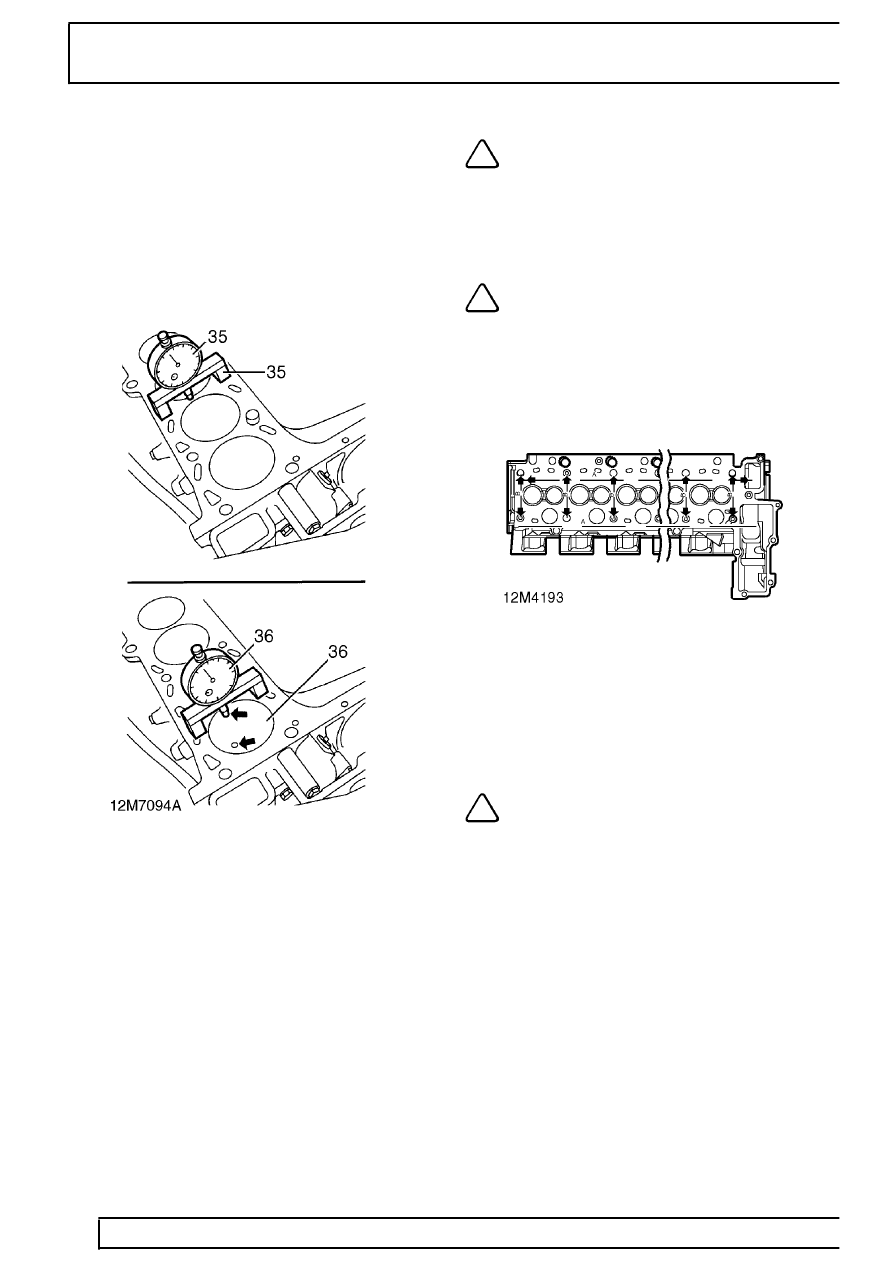
35. Position a dial gauge with suitable base to
cylinder block.
36. Preload and zero gauge on cylinder block face.
37. Move gauge onto piston crown. Measure
protrusion of No. 1 piston in two positions as
shown. Take average of readings. Record
results.
38. Repeat protrusion check on piston No. 6.
39. Remove timing pin LRT-12-108 from flywheel.
40. Record protrusion of remaining pistons. Ensure
that readings are taken at exactly TDC.
NOTE: Top Dead Centre must be located
using dial gauge.
41. Calculate average piston protrusion to determine
required gasket thickness:
Up to 0.76 mm = 2 identification holes
Over 0.76 mm = 3 identification holes
NOTE: If any piston protrudes more then
0.81mm, a gasket with 3 identification
holes must be fitted.
Cylinder head warp - check
42. Remove all traces of carbon and gasket material
from cylinder head.
43. Using a straight edge and feeler gauges, check
cylinder head for distortion along lines shown in
illustration and compare with figures given:
Longitudinal warp A = 0.1 mm (0.004 in)
Lateral warp B = 0.05 mm (0.002 in)
44. Replace cylinder head if figures obtained exceed
those given.
NOTE: Cylinder heads may not be refaced.
Parts & tools for this job Staging For Land Rover Range Rover
- PARTEngine gasket setSearch: Land Rover Range Rover engine gasket set
- TOOLTorque wrenchSearch: 3/8 inch torque wrench
- TOOLFeeler gauge setSearch: feeler gauge set
Links open Amazon search results in a new tab. As an Amazon Associate I earn from qualifying purchases.