
UNDER BONNET MAINTENANCE (page 3 of 4)
- Make
- Land Rover
- Model
- Range Rover P38
- Section
- MAINTENANCE
MAINTENANCE
5
MAINTENANCE
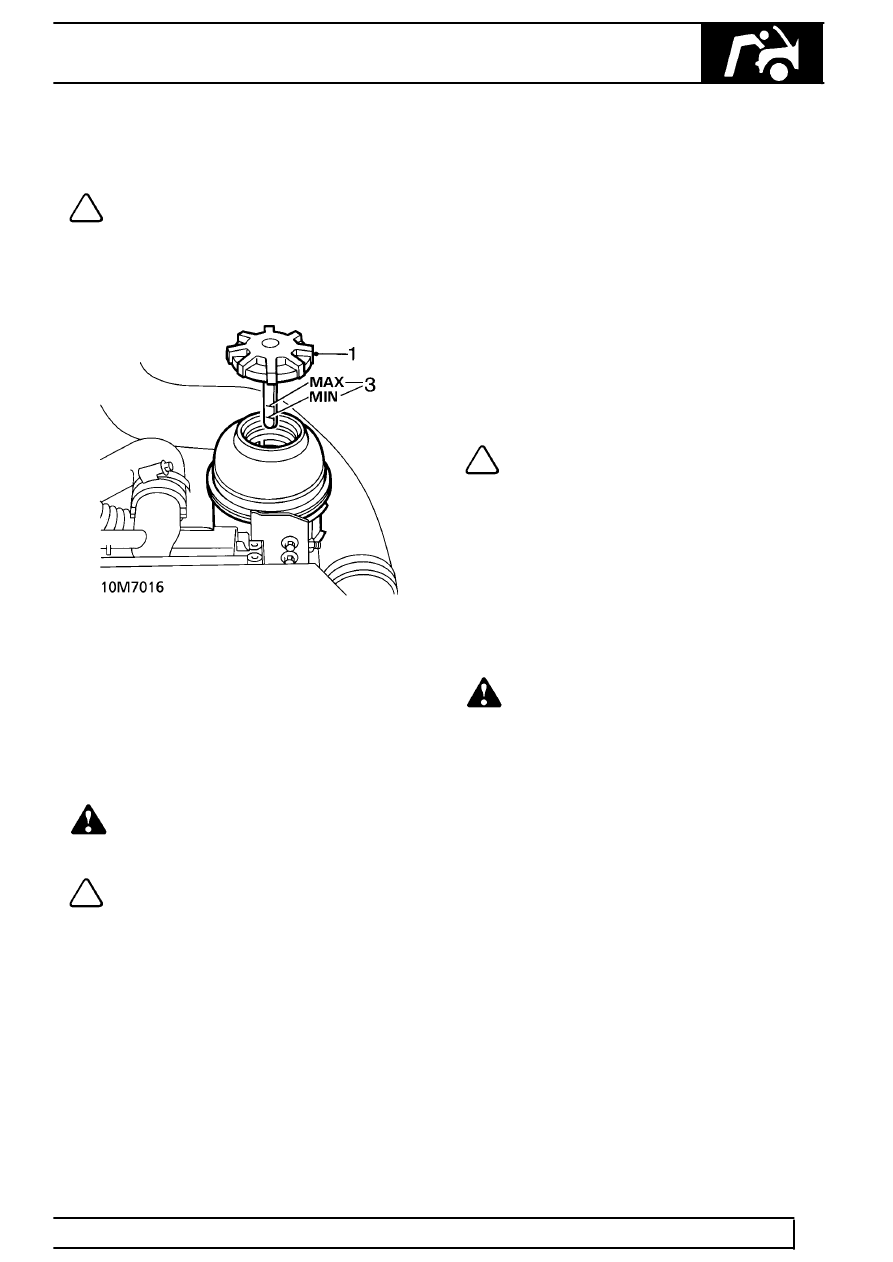
CHECK/TOP UP POWER STEERING FLUID
RESERVOIR
NOTE: Power steering fluid level is
checked when fluid is cold with engine
switched off.
1. Clean filler cap.
2. Remove dipstick, wipe using lint free cloth.
3. Fit cap fully, remove cap, check fluid level
registers between the two markings on the
dipstick. For fluid recommendations.
See
LUBRICANTS, FLUIDS AND CAPACITIES,
Information.
CHECK/TOP UP BRAKE/CLUTCH FLUID
RESERVOIR
WARNING: Clean reservoir body and filler
cap before removing cap. Use only fluid
from a sealed container.
NOTE: Clutch master cylinder is supplied
by the brake fluid reservoir. Use following
procedure if topping up is required.
1. Turn ignition ON, to activate hydraulic pump. If
pump does not activate, depress brake pedal
several times until it is heard to operate.
2. When pump stops, check that level is between
’MIN’ and ’MAX’ marks.
3. If level is below ’MIN’ mark on reservoir, top up,
using correct fluid.
See LUBRICANTS, FLUIDS
AND CAPACITIES, Information.
CHECK/TOP UP WASHER RESERVOIR
Top up washer reservoir to within 25 mm of bottom of
filler neck. Use the correct quantity of screen washer
additive to assist removing mud, flies and road film
and protect against freezing.
LUBRICATE ACCELERATOR AND CRUISE
CONTROL LINKAGES
REMOVE BATTERY CONNECTIONS
Clean, coat with petroleum jelly and refit terminals.
The exterior of the battery should be wiped clean to
remove any dirt or grease.
NOTE: From ’96 MY, the alarm sounder
may be fitted with a back-up battery, the
purpose of which is to power the anti-theft
alarm if the main battery is disconnected. On
these vehicles it is essential to adopt the following
procedure before disconnecting the terminals in
order to prevent the alarm from sounding:
1. Turn starter switch ’on’ and then ’off’.
2. Disconnect the battery WITHIN 17 SECONDS
(if the battery is not disconnected within 17
seconds, the alarm will sound).
WARNING: Hydrogen and oxygen gases
are produced during normal battery
operation. This gas mixture can explode if
flames, sparks or lighted tobacco are brought
near battery. When charging or using a battery in
an enclosed space, always provide ventilation and
shield your eyes.
Batteries contain sulphuric acid. Avoid contact
with skin, eyes, or clothing. Also, shield your eyes
when working near battery to protect against
possible splashing of acid solution. In case of
acid contact with skin, eyes, or clothing, flush
immediately with water for a minimum of fifteen
minutes. If acid is swallowed, drink large
quantities of milk or water, followed by milk of
magnesia, a beaten egg, or vegetable oil.
SEEK MEDICAL AID IMMEDIATELY.
A low maintenance battery is installed in the vehicle.
Dependent upon climate conditions electrolyte levels
should be checked as follows:
Temperate climates every three years.
Hot climates every year.
Parts & tools for this job Staging For Land Rover Range Rover
- PARTOil filterSearch: Land Rover Range Rover oil filter
- TOOLOil filter wrenchSearch: oil filter wrench
- FLUIDEngine oilSearch: Land Rover Range Rover engine oil
Links open Amazon search results in a new tab. As an Amazon Associate I earn from qualifying purchases.