
Anti-lock braking system – a.b.s.: Specifications
- Make
- Lancia
- Model
- Thesis Factory Service Manual
- Year
- 2002–2009
- Section
- Anti-lock braking system – a.b.s. › Specifications
Specifications
The vehicle is equipped with an ABS/EBD brake control system.
The ABS is fitted parallel to the hydraulic braking system so that should it not work braking would still be guaranteed.
The ABS incorporates the EBD function (Electronic Brake force Distribution) therefore the hydraulic system does not have a rear load proportioning valve.
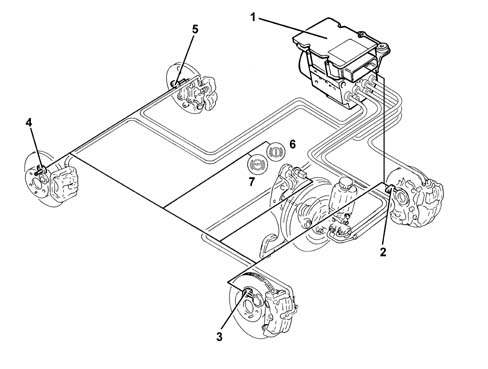
- 1 ABS/EBD control unit
- 2 Left front wheel sensor
- 3 Right front wheel sensor
- 4 Right rear wheel sensor
- 5 Left rear wheel sensor
- 6 EBD failure (6 and 7 on simultaneously)
- 7 ABS warning light
The A.B.S. control unit is connected to the C-CAN and is called the NFR (brake node).
The ABS control unit implements the EBD and ESP functions (vehicle dynamic control).
(See assembly ) 3350E VEHICLE STABILITY CONTROL SYSTEM
The ABS with ESP includes the ASR/MSR logic, the ASR also includes the TC logic (traction control).
The ABS control unit is connected to the front wiring, the system cable loom is incorporated with the engine compartment cable loom.
The ABS control unit with EBD has a different connector from the control units which has ASR and ESP functions.
The control unit receives and transmits information on the C-CAN and supports the following functions:
- acquiring a direct speed signal for the four wheels and processing and transmitting the signal via the C-CAN
- acquiring a direct signal for the drive wheel speed and processing and transmitting the signal via the C-CAN for the milometer
- sending the speed signal (V.S.O.) on a discreet line to the Body Computer (used if there are problems with the C-CAN
- directly acquiring the NA brake lights signal for the ABS, ASR and NA and NC for the ESP
- managing the ABS, ASR, EBS and ESP warning lights via the C-CAN line and acquiring feedback on the warning light status from the NQS
- Autodiagnosis on a direct line (K line).
The ABS pipes can be divided into three sections:
- pipes from the brake pump to the ABS control unit which, on versions with EPS, have a larger diameter and a "Titaflex" flexible section
- rigid connecting pipes from the ABS control unit to the front and rear flexible pipes. The rear brake pipes are divided into two sections, for fitting requirements, and they are protected by a special shield in the section exposed to the risk of damage.
- flexible connecting pipes between the rigid pipes and the brake calipers.
The rigid and flexible pipes are secured to the bodyshell by means of special brackets and/or fastening springs.
Parts & tools for this job Staging For 2002 Lancia Thesis
- PARTBrake padsSearch: Lancia Thesis 2002 brake pads
- TOOLBrake bleeder kitSearch: one man brake bleeder kit
- FLUIDBrake fluidSearch: brake fluid
Links open Amazon search results in a new tab. As an Amazon Associate I earn from qualifying purchases.