
Introduction - pistons and connecting rods
- Make
- Alfa Romeo
- Model
- 159 Factory Service Manual
- Year
- 2005–2011
- Section
- Pistons and connecting rods › Introduction - pistons and connecting rods
INTRODUCTION - PISTONS AND CONNECTING RODS
SPECIFICATIONS
The pistons are produced by aluminium alloy casting; the connecting rods are made from hardened and tempered steel, produced by hot pressing.
Both engine types have impressions for the valves and the combustion chamber and are cooled by an oil jet. The piston on the 2.2 JTS engine has a seat on the skirt to prevent interference with the jet nozzle.
The connecting rod caps are the fracture type joined by pressure using bolts, together with the half-bearings. The pistons and small ends are connected by means of a bush and pin kept in place by two circlips.
Since the connecting rod caps are produced by facture, each cap matches perfectly with the connecting rod that it comes from. When refitting the connecting rod caps, each cap must be matched with the connecting rod to which it belongs in order to prevent damage due to the imperfect matching of the surfaces.
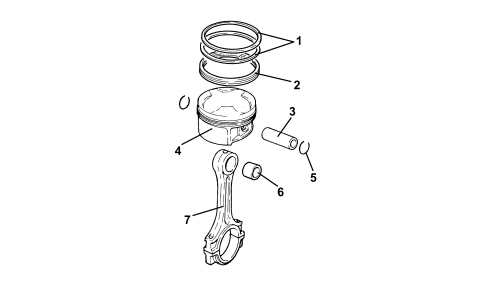
1. Piston rings
2. Oil scaper ring
3. Gudgeon pin
4. Piston
5. Piston rings
6. Bush
7. Connecting rod
Specifications
The pistons are produced through aluminium alloy fusion, whilst the connecting rods are made from steel.
The gudgeon pin is the floating type and works inside the bush inserted in the small end and is kept in place by two circlips.
The pistons have impressions for the valves and the combustion chamber in the crown; they are cooled at the bottom by an oil jet.
The compression seal is ensured by two bands, whilst there is a third band with three seals for the oil seal, one upper seal and one lower seal with an oil scraper ring in between.
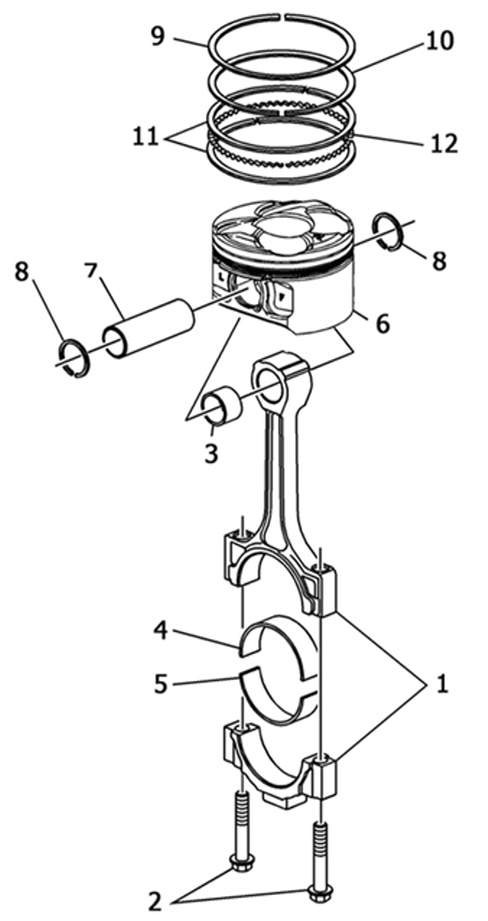
1. connecting rod and cap
2. bolts fixing connecting rod cap
3. small end bush
4. upper connecting rod half-bearing
5. lower connecting rod half-bearing
6. piston
7. gudgeon pin
8. circlip
9. upper band (compression)
10. lower band (compression)
11. oil seals
12. oil scraper ring
SPECIFICATIONS
The pistons are made from silicon aluminium alloy and are divided into three size categories with an arrow stamped on the crown that should be pointing towards the timing to ensure correct installation.
The piston crown is flat with four grooves to prevent interference with the valve heads.
The lower part of each cylinder liner/bore contains a jet that sprays oil onto the piston crown to cool it and to ensure the gudgeon pin is lubricated.
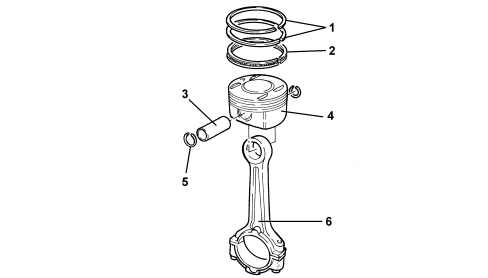
1. Piston rings
2. Oil scaper ring
3. Gudgeon pin
4. Piston
5. Piston rings
6. Connecting rod
The connecting rods are made from hardened and tempered steel produced through hot pressing. The connecting rod caps are the fracture type joined by pressure using bolts, together with the half-bearings. The pistons and small ends are connected by means of a bush and pin kept in place by two circlips.
Since the connecting rod caps are produced by facture, each cap matches perfectly with the connecting rod that it comes from. When refitting the connecting rod caps, each cap must be matched with the connecting rod to which it belongs in order to prevent damage due to the imperfect matching of the surfaces.
When fitting the piston, the reference on the lower part of the connecting rod indicates the side that should be facing the flywheel.
Parts & tools for this job Staging For 2005 Alfa Romeo 159
- PARTEngine gasket setSearch: Alfa Romeo 159 2005 engine gasket set
- TOOLTorque wrenchSearch: 3/8 inch torque wrench
- TOOLFeeler gauge setSearch: feeler gauge set
Links open Amazon search results in a new tab. As an Amazon Associate I earn from qualifying purchases.