
PASSIVE ENTRY NODE - Keyless-go
- Make
- Lancia
- Model
- Thesis Factory Service Manual
- Year
- 2002–2009
- Section
- Instrument/gauge electrical circuits › PASSIVE ENTRY NODE - Keyless-go
PASSIVE ENTRY NODE - Keyless-go
SPECIFICATIONS
The PASSIVE ENTRY system (NPE), connected to the B-CAN, is a Node which allows a particular management of the vehicle protection concerning entry into the passenger compartment and starting the engine.
In addition to the actual Node, the system also consists of a special device known as a CID (Customer Identification Device). This device allows whoever is in possession of it to be automatically identified by the vehicle, without the need to use buttons or carry out other actions: the owner of the vehicle simply has to have the CID with them (e.g. in their pocket) for the vehicle to recognize them and allow them to enter the passenger compartment and start up the engine.
Identification only takes if the owner is about 1 m from the door of the vehicle they wish to open: an authorized person who wishes to place themselves between the owner and the vehicle to open the door is therefore obliged to make physical contact with the owner. This guarantees security against unauthorized access.
It contains a transponder with codes programmed for the immobilizer (like the 2nd gen. Cod key), a batytery for suppling the remote control transmitter for the Alarm/Central locking system and 3 buttons for locking, unlocking and opening the boot; there is also a mechanical key to be used in emergencies if the keyless-go system is not working and for activating/deactivating the passenger Air Bag module.
This key does not allow the vehicle to be started up.
The transmission of a command is carried out by pressing one of the transmitter buttons. Whilst pressing the button, the LED in the transmitter flashes at a frequency of 3 Hz.
The transmitter signals that the batteries are run down by giving a single flash lasting 200 ms when the button is pressed.
The direction indicators and the LEDs in the door panel are used to signal that the command has been received and/or to signal that a manoeuvre has not been carried out by the system (the signals are activated according to the market).
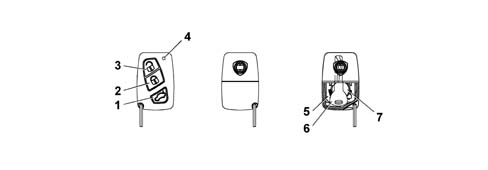
- 1 Boot unlocking button
- 2 Door locking button
- 3 Door unlocking button
- 4 LED
- 5 Printed circuit
- 6 Key
- 7 Battery
There is also an LED in the CID signalling activation.
There is a dedicated housing in the vehicle in the oddments compartment to keep the CID in for emergency manoeuvres or servicing in the workshop. This housing has an aerial for the immobilizer function.
Replacing the pawl in the ignition lock, on the version with the keyless-go system there is a control knob, in the same position, which allows the ignition ON and STARTING functions.
The rotation of the knob (with the steering locked) is enabled by the keyless-go system.
As there is no longer a classic starting lock, there is a Node that activates and deactives the steering lock (see Steering Lock Node - NBS), connected at the B-CAN.
Naturally, all the functions relating to the DEAD-LOCK, to setting the door/boot unlocking using the Connect, to the door locking and the signals described in the Central Locking and Alarm chapter also remain valid for the NPE - keyless-go.
The remote control receiver is integrated in the NPE.
Each time it is operated, the remote control sends the Body Computer information on the state of charge of its internal battery, if the remote control battery is run down, the appropriate message will be shown on the instrument panel display at the next key on.
CODE II system code programming - with Passive Entry
Up a maximum of 8 keys/CIDs can be programmed
CID RECOGNITION
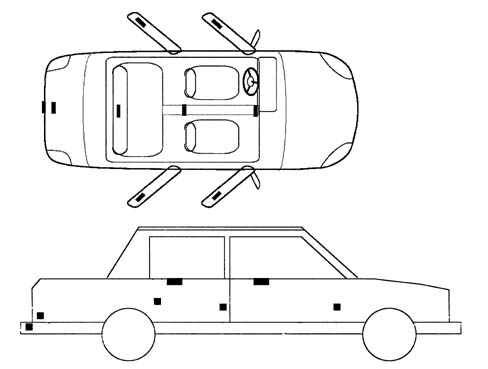
Once the position of the CID has been verified, it responds by transmitting its code via the RF aerial (433.92 MHz) connected to the NPE.
CID recognition from the outside
The NPE recognizes the CID in the position shown by the handle which is pulled waking up the B-CAN and energizing the aerial in the door of the handle operated.
If the handles on more than one door were pulled simultaneously (or almost), the recognition of the CID takes place following the order of priority described below:
- Driver's door
- Front passenger door
- Boot
- Driver's rear door
- Rear passenger door
CID recognition from the inside
Following a recognition request the NPE checks the presence of the CID from the inside. If no CID is found, the NPE automatically activates the search for the CID in the garage position.
If the CID is not recognized in the requested position (inside or garage position), the NPE signals to the NBC that the CID has not been found.
CID recognition in garage position
If communication between the aerials and the CID is not possible (CID battery run down) it is possible for the NPE to recognize the presence of a CID inside the vehicle by positioning it in the housing in the centre tunnel (garage position).
The passive reading of the CID takes place in the same way as the reading of a transponder: the immobilizer aerial in the garage position is capable of energizing the CID transponder to identify it allowing the exchange of codes between the CID and the NPE even if the CID battery is run down.
CID enabling/disabling strategy
Disabling
On the request for a locking command, the NPE searches for the CIDs present inside the passenger compartment. CIDs recognized inside the passenger compartment are temporarily disabled
In any case the CID that carried out the command operation is not disabled.
The disabled CIDs cannot be used in the case of break in attempts or attempts to start the vehicle by unauthorized persons.
At the time of the CID recognition request, the NPE checks whether a recognized CID is disabled: in this case it responds "CID not recognized".
if a CID is disabled, its operation as a radiofrequency remote control is also disabled.
Enabling
On the request for an unlocking command (for either the doors or the boot), all the CIDs temporarily disabled are enabled once again.
OPERATION OF KEYLESS-GO FROM CUSTOMER'S PERSPECTIVE
The keyless-go system is a system for access to the passenger compartment and engine starting that allows the customer to enter the vehicle and start up the engine without using the key, simply by carrying a CID.
The passive-entry system allows access to the passenger compartment, leaving the passenger compartment and access to the boot of the vehicle directly by the owner in possession of a CID.
It is therefore not necessary to use control components (key, remote control) to unlock the doors: the unlocking takes place automatically the moment an outside handle is pulled if it is authorized by a CID-vehicle recognition process.
The customer approaches the locked vehicle with their CID (e.g. in their pocket), pulls the handle and the system automatically recognizes them, unlocking the doors and switching off the alarm.
Once seated in the driver's seat, the customer with their CID, presses the clutch pedal (the brake pedal on vehicles with auto. trans.) and then turns the ignition knob to the ON position, unlocking the steering: the instrument panel and the electrical services are activated and the engine starts up. If the driver does not press the clutch, the knob cannot be turned.
Having reached their destination, the customer turns the knob from the ON position to the OFF position and the engine is switched off.
After the customer gets out of the vehicle and moves away, the system locks the vehicle automatically. The entire usage cycle for the vehicle consequently takes place without the need to use a key, either for opening/closing the vehicle (remote control function) or for switching the engine on/off (ignition key function).
OPERATION OF KEYLESS-GO AT SYSTEM LEVEL
The Passive Entry Node is basically capable of managing 2 actions by the user:
- entry into the vehicle, moving away from the vehicle
- engine starting
Vehicle entry/moving away
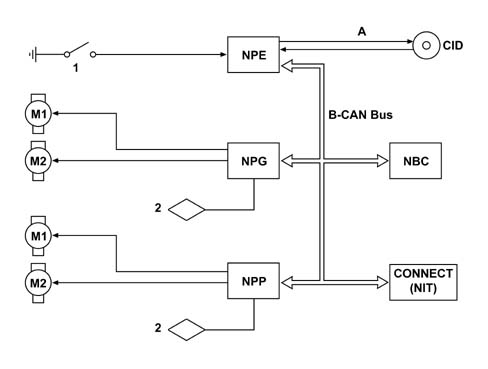
- 1 Handle switch (opening)
- 2 Door LED
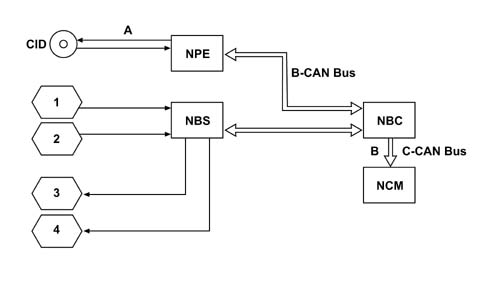
- A - CID presence check
- M1 - Dead-lock motor
- M2 - Locking/unlocking motor
During normal operation, the NBC makes the information on the state of the vehicle available to the network, in other words whether it is:
- closed/open,
- locked/unlocked
- alarm on/off.
The Connect provides the network with information concerning the setting the user has made before leaving the vehicle, i.e.:
- boot controlled by central lockign/boot constantly locked,
- unlocking of all doors/unlocking of driver's door only,
- Autoclose activated/Autoclose deactivated.
Access to Locked Vehicle
The owner of the vehicle with their CID approaches the vehicle and pulls the door handle: the lock releases and the door is released, allowing access to the passenger compartment.
At the same time, the alarm system is switched off and the locks for the other doors are unlocked, allowing access for the passengers as well (see "Unlocking driver's door" function).
The unlocking of the doors is signalled by the direction indicators flashing twice and two beeps: the green LEDs in the door panels come on for 3 seconds to signal that access to the passenger compartment is possible.
If the battery inside the CID is almost run down, at the time of activation the instrument panel will show a warning message through the Connect display (Electronic key battery run down) which warns the driver of the need to replace the battery as soon as possible.
Let us take a look at what happens on a functional level:
- pulling the handle
- the switch in the handle informs the NPE and the NPG/NPP/NVB of the action
- the NPE, NPG, NPP and NVB wake up the network
- The Door nodes wait for authorization from the NPE
- the NPE checks the CID via the aerial in the door
- If there is no CID, nothing happns and the system goes back to sleep
- If there is a CID and it is recognized, the NPE sends a command via the B-CAN to the NPG and NPP / NVB to authorize the opening and a vehicle unlocking command to the NBC
- NPx / NVB supply the door opening motors
- NBC sends an unlocking command to all the Nodes, switches off the alarm system and implements the signals
Driver's door unlocking
The "central unlocking" and "driver's door unlocking" settings for the central locking system also work for the passive-entry system, as follows:
- central unlocking (default setting): all the vehicle doors are unlocked at the same time and access is allowed through every door.
- driver's door unlocking: if access is through the driver's door, the other doors remain locked, preventing access to other unauthorized persons.
In this case the green LED in the driver's door panel comes on whilst the ones in the other doors remain off.
In the driver's door unlocking setting, all the doors can be unlocked, once the driver's door is open, by pressing the central unlocking button in the door panel to allow access for the passengers.
Opening luggage compartment with vehicle locked
The owner of the vehicle with their CID approaches the vehicle and pulls the boot opening handle: the lock releases and the luggage compartment is released; the doors remain locked.
If the alarm system is on, the perimeter protection of the boot, the volumetric protection and the tilt protection are temporarily excluded.
When the boot is closed again, it has to be re-locked by pressing the remote control door locking button which reactivates the alarm protection functions.
AUTOCLOSE function
The AUTOCLOSE function which can be activated and deactivated using the Connect menu, allows the automatic locking of the vehicle locks after the customer has moved away from the vehicle. After all the doors have been closed, the system begins a period check for the presence of one or more CIDs inside and outside the vehicle.
When no CID is detected, the system believes that the customer has moved away and commands the locking of the locks which is signalled by a beep from the alarm system.
The AUTOCLOSE functions does not switch on the alarm system, does not switch on the DEAD - LOCK and does not allow the steering lock function (by the NBS). If a fault is detected in the CID recognition system, the AUTOCLOSE function is disabled to prevent a CID being closed in the passenger compartment.
If the autoclose functin is enabled and the operating conditions are followed, the NPE starts the search for one or more CIDs. The search is carried out inside and outside the vehicle using the internal and external aerials.
Immediately after a change in state for the last door open and, if the starting conditions (listed below) are valid, the NPE starts to search inside the vehicle for any CIDs.
If a valid CID is recognized inside the vehicle, the autoclose procedure is interrupted until there is another change in state for one of the doors (open - > closed).
If no CID is recognized inside the passenger compartment, the search is repeated another two times (a total of 3 internal searches).
START OF CHECK
The starting condition is:
- transition from an open door - > closed door with all the other doors and boot closed at the time
- key/knob in OFF position
- no CID present inside the vehicle (a CID presence check has been carried out when the last door was closed, including the garage position)
vehicle not locked
CHECK STRATEGY
The check for the presence of a CID is carried out in the following order:
- driver's door
- driver's rear door
- boot
- passenger door
- rear passenger door
If no CID is recognized inside the passenger compartment the search is begun outside.
If a CID is recognized outside the vehicle, the checking operation is interrupted and begun again at the frequency shown in the table below.
If no CID is recognized for 3 checking sequences, the inside of the vehicle is checked again (inside and garage position) and if no CID is recognized in this position either, a door locking command is produced.
Prevention of CID battery discharge
In order to preserve the CID battery charge, the CID scanning strategy when moving away from the vehicle is illustrated in the table below.
| Time interval since moving away from the vehicle | Scanning frequency | |
|---|---|---|
| from | to | |
| 0 seconds | 5 minutes | continuously |
| 5 minutes | 60 minutes | one sequence every 5 seconds |
| 60 minutes | 24 hours | one sequence every 60 seconds |
| from 24 hours onwards | no more sequences are carried out (function no longer activated) | |
The function is not activated in the following cases:
- one or more internal aerials out of use
- CID battery run down
- garage use
- vehicle battery run down (voltage < 7 Volt)
Let us take a brief look at what happens on a functional level:
- closing of the last door/boot,
- if there is a fault in the aerials, the NPE does not activate the function
- the NPE checks for the presence of a CID inside or outside the vehicle in the following order: driver's door - driver's rear door - boot - passenger door - rear pasenger door
- The moment no CID is present inside or outside the vehicle, the NPE commands the central locking by the NBC after about 2 seconds
- the NBC sends the command to lock the doors to the door nodes and carries out the signalling but does not switch on the alarm
Locking Unlocking doors using the CID remote control
The strategies implemented by the door locking unlocking using the CID remote control are the same as those described in the "RADIOFREQUENCY REMOTE CONTROL CENTRAL LOCKING SYSTEM".
The action of locking the locks can take place using the CID remote control button or directly using the mechanical key (inside the CID) for the door pawl.
If it takes place using the R.F. remote control, the aerial transmits the command to the NPE which, in turn, retransmits it to the NBC via the B-CAN.
If, on the other hand, it takes place using the mechanical key in the front door pawl, the switches advise the respective door nodes (NPG for the left door and NPP for the right door) and they transmit the information via the B-CAN to the NBC.
At this point the NBC manages the locking of the doors, which is always implemented for all the doors, sending the signal via the B-CAN to the NPG, NPP and NVB nodes.
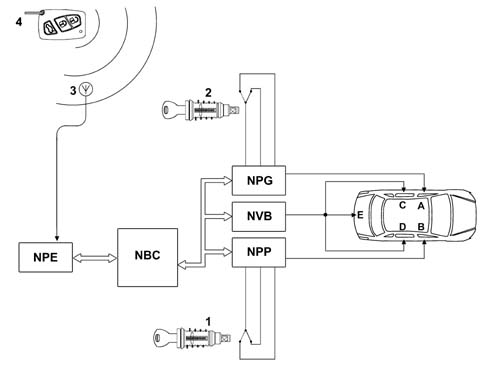
- A- Left front door lock
- B- Right front door lock
- C- Left rear door lock
- D - Right rear door lock
- E - Boot lock
- 1 Right front door pawl
- 2 Left front door pawl
- 3 Aerial
- 4 CID
Emergency situation
If the internal CID battery is run down or not working properly, the unlocking of the doors and access to the passenger compartment takes place using the mechanical insert integrated in the CID (to deactivate the alarm, see alarm "emergency" function).
In the same way, when the vehicle is abandoned, the locks have to be locked using the mechanical insert: in this case, the dead-lock cannot be engaged.
If the vehicle battery is run down, access to the passenger compartment is possible by unlocking the front doors only using the mechanical insert: the other doors remain locked.
Inhibition: locking doors / engaging dead-lock using remote control
The CID has remote control functions and the dead-lock can therefore be engaged using the buttons on the CID. If one of the CID buttons is pressed by mistake when it is inside the passenger compartment, the Passive Entry system does not engage the dead-lock to prevent the customer from being accidentally locked inside the vehicle.
Let us take a look at what happens on a functional level:
- pressing the CID locking button
- the NPE receives the command via the R.F. aerial
- the NPE commands the NBC to lock the doors
- the NBC sends the locking command via the B-CAN and implements the signals and switches on the alarm
- In parallel to point 3, the NPE checks for the presence of the CID that has sent the command via the internal aerials
- If the CID is inside the passenger compartment, the NPE sends an unlocking command to the NBC within 2 seconds
- the NBC sends the door unlocking command via the B-CAN and implements the signals and switches off the alarm
- the NPx and NVB implement the unlocking
Engine starting
- 1 Starting knob
- 2 Clutch switch (brake for automatic transmission)
- 3 Steering release actuator
- 4 +15/+50/INTA
- A - CID presence check
The following components are involved in starting the engine:
- start/stop knob in the dashboard
- electric steering lock (NBS) which locks/releases the steering column
- the clutch pedal, used to enable the starting manoeuvre.
- brake pedal (automatic transmission only), used to enable the starting manoeuvre
- accelerator pedal which allows emergency starting in the case of system malfunctions
Steering Locking/Release and activation of instrument panel
STEERING LOCK
The steering lock locking strategy is managed by the NBC.
With the engine switched off (knob in OFF position), the clutch pedal (or brake pedal for vehicles with automatic transmission) released, a command to lock the doors causes the steering to be locked (except for the locking of the doors by the mechanical insert or the Autoclose function).
When the locking command is received from the CID (door locking button on the CID), the NBC checks for the simultaneous presence of the following conditions:
- clutch/brake pedal released
- no "+15"
- vehicle stationary
If the above mentioned conditions are not verified when the locking command is received from the CID, the locking of the steering is not controlled by the NBC.
If the above conditions are verified, the NBC, after a delay of 3 seconds from receiving this command, controls the locking of the steering if no commands to unlock the doors are received in the meantime.
If during this 3s delay, the NBC receives any door unlocking command, the procedure is aborted and the steering is not locked.
the autoclose function or the closing of the doors using the mechanical insert do not activate the steering lock in any circumstances
Let us take a look at what happens on a functional level:
- Pressing the door locking button in the CID remote control
- the NPE wakes up the network
- the NPE sends a vehicle locking command to the NBC via the B-CAN
- the NBC sends a locking command to all the nodes, switches on the alarm system and implements the signals
- the NBC checks that there is no +15
- the NBC waits for 3 seconds
- the NBC sends the NBS the steering lock command via the B-CAN
- the NBS receives the command and locks the steering.
it is possible, using the Connect setting, to disable the steering lock functino controlled by the door locking
STEERING RELEASE
The steering lock release strategy is managed by the NBC.
The driver with their CID, presses the clutch pedal (the brake pedal on vehicles with auto. trans.) and then turns the ignition knob to the ON position, unlocking the steering: the instrument panel and the electrical services are activated.
If the driver does not press the clutch, the knob cannot be turned.
once the knob is turned to the ON position, if the driver abandons the vehicle taking the CID with them, the services remain activated and the steering released. It is therefore not possible to start the engine unless authorized.
After the clutch/brake pedal is pressed, the NBC wakes up the network and requires the CID internal presence check. If the CID is present either inside the passenger compartment or in the garage position, the NBC carries out the request to the NBS to release the steering lock.
If the +15 signal is activated, the procedure is not activated: the pressing of the clutch is then detected by the NBC but this does not produce a CID recognition request and does not activate the steering release procedure (no command is sent to the NBS).
If there is a valid CID in the passenger compartment, when the knob is turned this will have no effect on the system and the following message will be displayed on the instrument panel: "ELECTRONIC KEY NOT RECOGNIZED"
Let us take a look at what happens on a functional level
- the NBC acquires the pressing of the clutch pedal (brake for automatic transmission)
- the NBC wakes up the network
- the NBC requests the NPE to check for the CID inside the passenger compartment
- the NPE checks for a CID inside the passenger compartment on in the garage position. If a CID is present, the NPE confirms this to the NBC which, in turns enables the NBS at +15. The NBS then releases the steering, checks that it has been released and activates the +15. If there is no CID present, the NPE sends the NBC information that the CID has not been found, the NBC sends this information to the NQS and the NQD displays the CID not recognized information in the display.
Engine starting
The driver turns the ignition knob to the Starting position: the engine is only started if there is a CID in the passenger compartment.
If, during the starting manoeuvre, the CID is not in the passenger compartment or the CID battery is run down, the instrument panel is activated and it signals the impossibility of starting the engine through the following message: ELECTRONIC KEY NOT RECOGNIZED" and, as a result, the starter motor does not turn.
The pressing of the clutch pedal is requested to confirm the user's effective desire to start up the engine.
Let us take a look at what happens on a functional level:
- the NBC detects the INT/A signal and the pressing of the clutch pedal (N.a. switch), (brake for automatic transmission)
- the NBC wakes up the network
- the NBC requests the NPE to check for the CID inside the passenger compartment
- the NPE checks for a CID inside the passenger compartment on in the garage position. If a CID is present, the NPE confirms this to the NBC which, in turns enables the NBS at +15. The NBS then releases the steering, checks that it has been released and activates the +15. If there is no CID present, the NPE sends the NBC information that the CID has not been found, the NBC sends this informatino to the NQS and the NQD displays the CID not recognized information in the display.
- the NBC sends the NBS the enablement for starting when the INT/A position of the ignition switch is exceeded going from +15 to +50 (and disablesit when the switch returns below the INT/A position)
- the NBS checks that the clutch/brake pedal is pressed (N.C. switch)
- the NBS checks that the knob is turned
- the NBS enables starting (+50) directly operating the starting relay.
- the NBS acquires the release of the knob and removes the +50
the clutch pedal switch is the dual type: when pressed it provides one signal for the NBC (N.A. switch) and one for the NBS (N.C. switch)
If the INT/A signal is detected within 5 seconds of the last "+15", the CID recognition is no longer requested (the steps from 2 to 3 are not carried out); this is something that takes place if this time is exceeded:
The engine cannot be started if the CID is inside the boot.
It is possible that the moment the starting knob is turned the systm is not capable of recognizing the CID becase it is not working or because the CID battery is run down. In this case the CID is placed in the garage position in the centre console. At the key-on, the aerial is supplied like in the code II system and the magnetic field produced "activates" the CID transponder which, if recognized, enables the system for starting (also see "Recognition of CID in garage position"). If the CID is remobved from the garage position whilst driving, the engine will remain running. The CID should be returned to the garage position for a subsequent starting.
If the vehicle battery is run down, no steering release or starting manoeuvre can be carried out
STARTING ANTI-REPETITION
The anti-repetition function is implemented by the NBC. If an unsuccessful starting manoeuvre has been carried out, the knob should be returned to the OFF position before repeating the procedure (like on conventional systems).
CHECKING FOR PRESENCE OF CID IN PASSENGER COMPARTMENT WITH ENGINE ALREADY RUNNING
With the instrument on or the engine running, when the doors are closed the system checks for the CID in the passenger compartment.
If the CID is not present (because the cutomer has moved away or as a result of a deterioration in performance for any reason), the system shows the "ELECTRONIC KEY NO LONGER PRESENT IN THE VEHICLE - VEHICLE CANNOT BE RESTARTED" message on the display.
ENGINE CUTTING OUT
The driver turns the knob from the ON position to the OFF position: the engine cuts out. The message "The steering is locked with the doors closed" appears on the instrument panel to remind the user to carry out this locking.
Parts & tools for this job Staging For 2002 Lancia Thesis
- TOOLDigital multimeterSearch: automotive digital multimeter
- PARTAssorted fuse kitSearch: car fuse assortment kit
- TOOLWire crimper and connector kitSearch: wire crimper connector kit
Links open Amazon search results in a new tab. As an Amazon Associate I earn from qualifying purchases.