
Fap system
- Make
- Fiat
- Model
- Ulysse Factory Service Manual
- Year
- 2002–2010
- Section
- General › Fap system
FAP SYSTEM
- manage the control function requirements,
- acitvate the functions necessary for regeneration,
- determine the regeneration aid level needed,
- check the impact of post-injection on the operation of the engine.
The regeneration of the filter depends on the temperature of the exhaust gases and is activated beyond the particle combustion level (around 450°C if the additive function is present).
There are two types of regeneration:
- natural regeneration,
- artificial regeneration.
Natural regeneration
When the temperature of the exhaust gases approaches the regeneration level (with the additive function around 450 °C), the particles burn naturally inside the filter. In this case no intervention is required by the engine management node.
Driving conditions directly affect the temperature of the exhaust gases and, consequently, the temperature inside the filter.
Artificial regeneration
Artificial regeneration is managed by the engine management node by means of commands designed to increase the temperature of the exhaust gases until the particle combustion level is reached.
Artificial regeneration involves two stages:
- stage 1: increase in the temperature of the catalytic converter,
- stage 2: increase in the temperature of the exhaust gases.
The engine management node manages the change from the first stage to the second stage according to the temperature of the exhaust gases upstream and downstream of the catalytic converter; this change is not permitted until the first stage has been activated for a certain period or the temperature of the exhaust gases upstream and downstream of the catalytic converter have reached pre-set values.
Each time the artificial regeneration is activated, the engine management node:
- interrupts the exhaust gas recirculation (EGR);
- operates the turbine to keep the engine torque constant,
- if necessary, controls the opening of the valve for heating the intake air (through the reversal of the position of the two control valves),
- activates post-injection (which heats the exhaust gases directly),
- requests the activation of several electrical consumers.
Artificial regeneration - first stage
When first stage artificial regeneration is required, the engine management node adapts the post-injection strategies to increase the temperature of the catalytic converter.
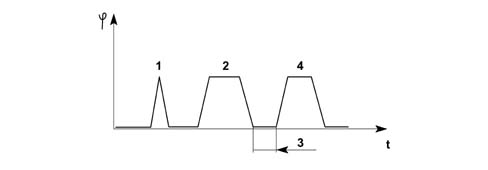
- 1 pilot injection
- 2 main injection
- 3 first post-injection period
- 4 post-injection
Post-injection takes place immediately after the main injection which makes it possible to increase the temperature of the exhaust gases through combustion in the cylinder after top dead centre.
This stage ensures an increase in the temperature of the catalytic converter until the maximum efficiency level is reached.
By comparing the temperature of the exhaust gases upstream and downstream of the catalytic converter, the engine management node uses its internal strategy to determine whether the catalytic converter has reached its maximum conversion level; when this level is reached, it activates the second artificial regeneration stage.
Artificial regeneration - second stage
At the end of the first artificial regeneration stage, the engine management node implements strategies that allow a further increase in the temperature of the exhaust gases (second stage).
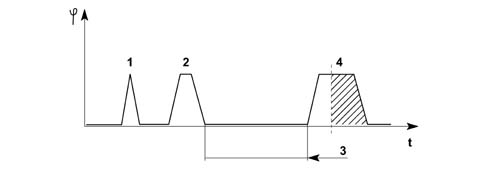
- 1 pilot injection
- 2 main injection
- 3 first post-injection period
- 4 post-injection
The period that separates the main injection from the post-injection is longer than for the first stage, the post-injection period is longer and is divided into two parts:
- the first allows the temperature of the exhaust gases to be kept high,
- the second allows the hydrocarbons (HC) required for post-combustion to be supplied to the catalytic converter.
Artificial regeneration activation conditions
Before activating the artificial regeneration strategies, the engine management node checks that:
- the temperature of the engine coolant is ³ 60°C,
- the engine speed is equal to a pre-set level, artificial regeneration is inhibited during idling,
- the vehicle has travelled at least 280 km since the last regeneration.
The filter blockage level due to particles is controlled by means of two parameters:
- the mileage between each regeneration (N1),
- differential pressure (?Pn).
Counting the distance travelled
The information relating the distance travelled since the last regeneration (calculatd by the engine management node), makes it possible to activate the artificial regeneration independently of the information supplied by the differential pressure sensor. This strategy makes it possible to limit the mass of particles to be burnt by the filter since the combustion of a high level of particles could increase the temperature of the filter too much causing it to be ruined.
The engine managment node activates artificial regeneration strategies when the distance travelled since the last regeneration reaches a pre-set value, which varies according to the aging of the filter (quantity of cerium oxide accumulated).
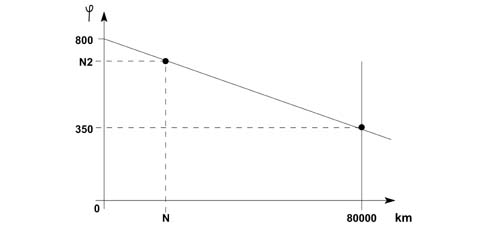
- f - regeneration frequency (expressed in km)
- km - total mileage
- N - aging of the filter (total mileage for the filter),
- N2 - mileage determining the activation of the regeneration
when N1 (mileage since the last regeneration) ³ N2 the engine management node establishes the start and the duration of a period of time (T2) during which post-injection takes place.
The graph below illustrates the activation of artificial regeneration according to the mileage parameter.
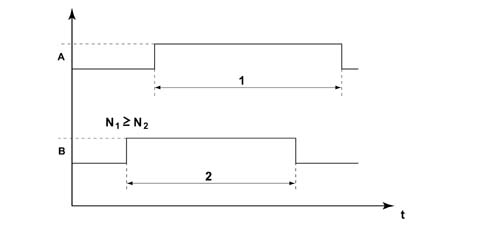
- A - regeneration
- B - post-injection
- 1 combustion of the particles (variable duration)
- 2 post-injection time (T2)
If the post-injection cycle is interrupted (for example because the engine cuts out), it will be resumed for a period of T = T2 when conditions permit.
Differential pressure sensor signal
The signal from the differential pressure sensor activates the artificial regeneration strategies independently of the mileage since the last regeneration.
To stop artificial regeneration activated by the differential pressure signal:
- the filter operating zone must be lower than the initial level,
- the period during which post-injection takes place (established by the engine management node) must have elapsed.
Taking into consideration that:
- ?Pn is the value of the differential pressure that determines the activation of artificial regeneration (varying in accordance with the total mileage of the FAP),
- ?Py is the value of the differential pressure measured by the engine management node,
when ?Py = ?Pn the engine management node establishes the start and the duration of a period of time (T1) during which post-injection takes place and a differential pressure value ?Pz is reached. At the end of the period T1 or when the differential pressure value ?Pz is reached, regeneration stops.
The graph below illustrates the activation of artificial regeneration according to the pressure value parameter.
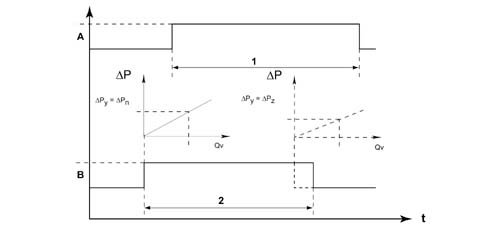
- A - regeneration
- B - post-injection
- 1 combustion of the particles (variable duration)
- 2 post-injection time (T1)
If the post-injection cycle is interrupted (for example because the engine cuts out), it will be resumed for a period of T = T1 when conditions permit.
"Economy" artificial regeneration
Artificial regeneration (mileage or differential pressure) can be activated in a way known as "economy".
The strategies remain unchanged compared with the previous description, but the injection times are shorter. This allows the regeneration of the filter with less fuel consumption.
This mode can be activated when the filter blockage level is not too high or when the mileage since the last regeneration is close to the limit. If conditions are favourable, the engine management node brings forward regeneration limiting fuel consumption for the actual regeneration.
The parameters required for activating this mode are:
- engine speed and load conditions favourable for rengeration for a set period (e.g. 80 km/h maintained for a period of more than 1 minute),
- N and ?P close the values in the "economy" mode activation area.
Activation of artificial regeneration in "economy" mode according to the mileage parameter (N)
The graph below illustrates the activation of artificial regeneration in "economy" mode according to the mileage parameter (N).
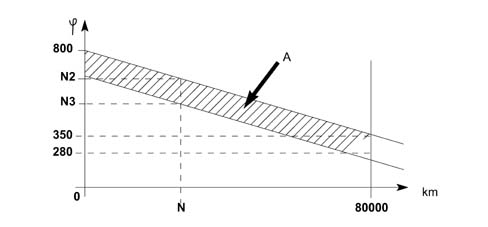
- f - regeneration frequency (expressed in km)
- km - total mileage
- A - "economy" mode activation area
- N - aging of the filter (total mileage for the filter),
- N2 - mileage determining the activation of the regeneration
- N3 - mileage at the start of the "economy" mode activation area
when N1 (mileage since the last regeneration) % N3 and driving conditions are optmum, the engine management node establishes the start and duration of the post-injection period (T3) at the end of which regeneration stops.
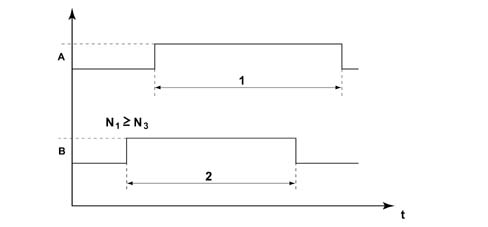
- A - regeneration
- B - post-injection
- 1 combustion of the particles (variable duration)
- 2 post-injection time (T3)
Activation of artificial regeneration in "economy" mode according to the differential pressure parameter (DeltaP)
Taking into consideration that:
- reduces the fuel flow rate during the main injection,
- modulates turbo pressure.
when ?Py ³ ?Px and in optimum driving conditions, the engine management node decides to bring forward regeneration, establishing the start and duration of the post-injection period (T4) and the differential pressure value ?Pw to be reached.
At the end of the post-injection period or when the differential pressure value ?Pw is reached, regeneration stops.
The graph below illustrates the activation of artificial regeneration in economy mode according to the differential pressure value parameter ?P.
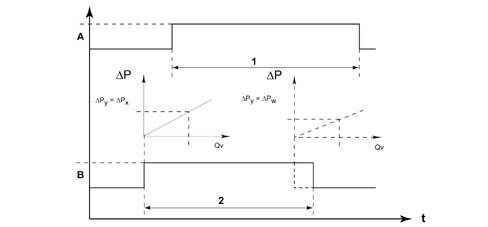
- A - regeneration
- B - post-injection
- 1 combustion of the particles (variable duration)
- 2 post-injection time (T4)
Effects of the activation of artificial regeneration
Effect on the injected fuel flow rate and on engine torque
Post-injection
During post-injection the fuel is injected after the piston has passed top dead centre. The temperature of the exhaust gases gradually increases until the regeneration level is reached.
The capacity, duration and time of the start of post-injection are determined by strategies that take the engine operating conditions and the level of assistance required into account.
Engine torque
When engine speed and load conditions are constant, post-injection produces an increase in engine torque. To maintain the same driving conditions and prevent a variation in engine torque, the engine management node:
- the switching on of the heated rear windscreen,
- the switching on of the radiator cooling fan at low speed,
- the switching on of the radiator cooling fan at medium speed,
- the switching on of the heater plugs.
Reduction in the fuel flow rate during the main injection
The reduction in the fuel flow rate during the main injection makes it possible to cancel the increase in torque due to post-injection.
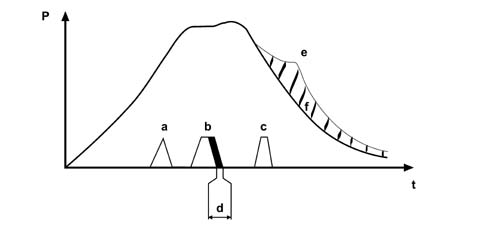
- a - pre-injection
- b - main injection
- c - post-injection
- d - reduction in main injection time
- e - increase in torque due to post-injection
- f - reduction in cylinder pressure
Regulation of supercharging pressure
In order to keep the engine torque unchanged during artificial regeneration, the engine management node reduces the supercharging pressure, restricting the flow of exhaust gases inside the turbine.
Activation of the high pressure pump third piston
During artificial regeneration the high pressure pump third piston is also activ ated to ensure the correct fuel flow rate required for post-injection.
Activation of electrical consumers
The activation of electrical consumers causes the engagement of the alternator and, as a result, an increase in resistant torque. This situation facilitates an increase in the temperature of the exhaust gases.
The engine management node request the body computer to switch on the electrical consumers that absorb a great deal of power, in the following order:
Regulation of the exhaust gas recirculation
Each time artificial regeneration is activated, the engine management node stops the exhaust gas recirculation (EGR): exhaust gas recirculation solenoid valve closed (this condition allows priority to be given to the management of the turbo).
Regulation of the intake air heating circuit
Each time artificial regeneration is activated, the engine management node keeps the throttle valve on the air/water heater duce open and closes the one of the intercooler duct in order to force the flow of air inside the actual heater.
Parts & tools for this job Staging For 2002 Fiat Ulysse
- PARTEngine gasket setSearch: Fiat Ulysse 2002 engine gasket set
- TOOLTorque wrenchSearch: 3/8 inch torque wrench
- TOOLFeeler gauge setSearch: feeler gauge set
Links open Amazon search results in a new tab. As an Amazon Associate I earn from qualifying purchases.