
Introduction - TIMING SYSTEM
- Make
- Fiat
- Model
- Doblò Factory Service Manual
- Year
- 2000–2010
- Section
- Timing system › Introduction - TIMING SYSTEM
Introduction - TIMING SYSTEM
The timing system is the collection of components which control the opening and the closing of the inlet and exhaust valves allowing the flow of the air/fuel mixture and burnt gases.
These components are operated by the crankshaft and the movement is transmitted via a toothed belt to the camshafts which, in turn, act on the valves. The various components should be perfectly synchronized (TIMED), if this is not the case, the valves could foul against the upper part of the pistons.
There are the same number of suitably positioned cams as there are valves to operate; at the front, it is prepared for the fitting of the toothed pulley, through which the motion of the crankshaft is received, by means of a suitably tensioned belt (see ''repair procedures'' section).
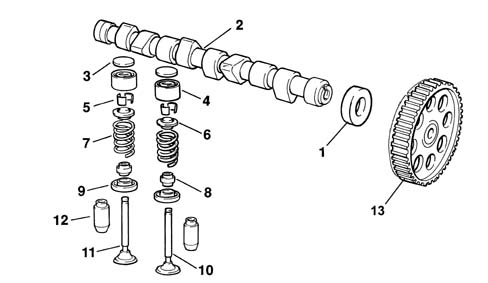
1, Camshaft oil seal
2, Camshaft
3, Tappet adjustment shim
4, Tapppet
5, Cotters
6, Upper shim
7, Spring
8, Oil seal
9, Lower shim
10, Inlet valve
11, Exhaust valve
12, Valve guide
13, Camshaft pulley
The camshaft is the component which, through the cams, opens the valves for the required time.
Since in 4 stroke engines the working cycle takes place during two revolutions of the crankshaft, whilst the valves have to open only once during the cycle, the camshaft only has to rotate once; therefore, the toothed pulley fitted on the camshaft will have twice the number of teeth as the pulley fitted on the crankshaft.
CAMSHAFTS
Two overhead camshaft, made from spheroid cast iron, operated by a toothed belt.
There are the same number of suitably positioned cams as there are valves to operate. at the front, it is prepared for the fitting of the toothed pulley, through which the motion of the crankshaft is received, by means of a suitably tensioned belt (see ''repair procedures'' section).
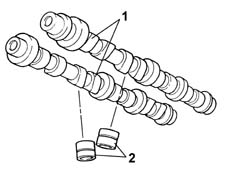
Hydraulic tappets
The hydraulic tappets automatically cancel the valve clearance during engine operation, with the advantage of reducing:
- maintenance interventions
- engine noise.
Operation in open stage
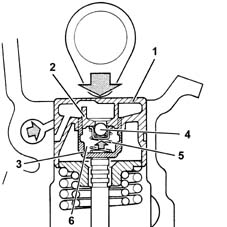
When the camshaft cam acts on the cup (1) and consequently the piston (2), the oil trapped in the chamber (6), because the ball valve (4) closes, transmits the movement of the piston (2) directly to the sleeve (3) and so to the valve. During this stage, because of the high pressure to which it is subjected, some of the oil in the chamber (6) leaks through the tiny gap between the piston (2) and sleeve (3).
Operation in closed stage
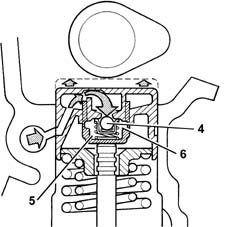
While the valve is closed, so that the tappet, pushed by the action of the spring (5), follows the profile of the cam, a vacuum is created inside the chamber (6) which causes the ball valve (4) to open, allowing oil to enter. The oil entering the chamber (6) replaces the oil which leaked out previously while the valve was open.
There are the same number of suitably positioned cams as there are valves to operate. At the front, it is prepared for the fitting of the toothed pulley, through which the movement of the crankshaft is received, by means of a suitably tensioned belt.
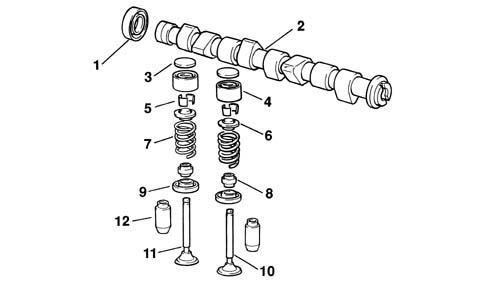
1, Oil seal
2, Camshaft
3, Adjustment shim
4, Tapppet
5, Cotters
6, Upper shim spring
7, Spring
8, Oil seal
9, Lower shim
10, Inlet valve
11, Exhaust valve
12, Valve guide
The camshaft is the component which, through the cams, opens the valves for the required time. Since in 4 stroke engines the working cycle takes place during two revolutions of the crankshaft, whilst the valves have to open only once during the cycle, the camshaft only has to rotate once; therefore, the toothed pulley fitted on the camshaft will have twice the number of teeth as the pulley fitted on the crankshaft. therefore, the toothed pulley fitted on the camshaft will have twice the number of teeth as the pulley fitted on the crankshaft.
SPECIFICATIONS
A cast iron overhead camshaft operated by a timing belt.
COMPOSITION
There are the same number of suitably positioned, profiled cams on the shaft as the valves to be operated; at the front there is provision for fitting a toothed pulley through which to receive movement from the crankshaft by means of a suitably tensioned timing belt.
On the 1.4 8v version the toothed pulley is incorporated in the phase transformer described below.
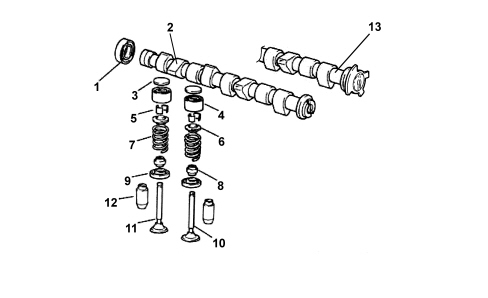
1. Crankshaft oil seal
2. Camshaft (1.2 8v version)
3. Tappet adjustment shim
4. Tappets
5. Cotters
6. Upper shim
7. Spring
8. Oil seal
9. Lower shim
10. Inlet valve
11. Exhaust valve
12. Valve guide
13. Camshaft with phonic wheel (1.4 8v version)
PHASE TRANSFORMER (1.4 8v version only)
Specifications
The 1.4 8v EVO2 engine is equipped with a "continuous" phase transformer capable of modifying the position of the camshaft in relation to the crankshaft.
In this way the engine is working with optimum timing in all operating points.
The phase transformer is managed entirely by the engine management control unit which:
- detects the camshaft position via the timing sensor;
- alters this position according to the engine operation on the basis of a calibrated map;
- keeps the camshaft position under control.
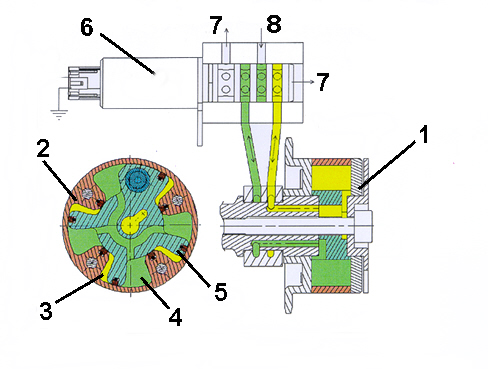
1. Driven pulley
2. Stator
3. Advance compartment
4. Delay compartment
5. Rotor
6. Cassette solenoid valve
7. Oil return
8. Oil inlet
Operation
The phase transformer actuator comprises a rotor in one piece with the camshaft that can rotate in relation to the pulley (stator) moved by the crankshaft. The rotor is equipped with vanes and moves through the effect of the engine oil pressure on the vanes.
There are two compartments (the advance compartment and the delay compartment) created at the two sides of each of these vanes: the oil can flow into one compartment or the other.
The pressure of the oil entering a compartment pushes the vane to one side and the oil in the other compartment is discharged to the cylinder head. The rotor is and consequently the camshaft are thereby rotated in a certain direction (advance or delay).
If the engine oil alternatively enters one compartment and the other continuously for the same time, the pressures at the two sides of the rotor are dynamically balanced and it remains still.
The flow of engine oil is activated by a cassette solenoid valve which places the oil ducts in the cylinder head in contact with the advance or delay compartments.
Parts & tools for this job Staging For 2000 Fiat Doblò
- PARTEngine gasket setSearch: Fiat Doblò 2000 engine gasket set
- TOOLTorque wrenchSearch: 3/8 inch torque wrench
- TOOLFeeler gauge setSearch: feeler gauge set
Links open Amazon search results in a new tab. As an Amazon Associate I earn from qualifying purchases.