
Introduction - ENGINE
- Make
- Fiat
- Model
- Doblò Factory Service Manual
- Year
- 2000–2010
- Section
- General › Introduction - ENGINE
Introduction - ENGINE
Hardened and tempered steel
Heat treatment applied to special steels to improve their mechanical characteristics: it consists of hardening, followed by tempering to induce a significant increase in toughness of the material.
Tempering: consists of heating to a temperature of < 720° Χ φολλοωεδ βψ σλοω χοολινγ, in order to attenuate the effects of the hardening without eliminating its effects.
The material thus returns to a condition as close as possible to a stable chemical-physical balance.
Hardening: this is obtained when the structure of the metal at high temperature is harder and stronger than when cold.
CURRENT DEVELOPMENTS
These engines are fitted with ''Magneti Marelli Common Rail' high pressure electronic injection systems for fast diesel engines totally managed by a Multijet MJD 6JF electronic control unit.
Hardened and tempered steel
Heat treatment applied to special steels to improve their mechanical characteristics: it consists of hardening, followed by tempering to induce a significant increase in toughness of the material.
Tempering: consists of heating to a temperature of < 720° Χ φολλοωεδ βψ σλοω χοολινγ, in order to attenuate the effects of the hardening without eliminating its effects.
The material thus returns to a condition as close as possible to a stable chemical-physical balance.
Hardening: this is obtained when the structure of the metal at high temperature is harder and stronger than when cold.
HARDENED AND TEMPERED STEEL
Special steel which has undergone a hardening and tempering treatment.
Heat treatment applied to special steels to improve their mechanical characteristics: it consists of hardening, followed by tempering to induce a significant increase in toughness of the material.
Tempering: consists of heating to a temperature of < 720° Χ φολλοωεδ βψ σλοω χοολινγ, in order to attenuate the effects of the hardening without eliminating its effects. The material thus returns to a condition as close as possible to a stable chemical-physical balance.
Hardening: this is obtained when the structure of the metal at high temperature is harder and stronger than when cold.
CONTROL AREA NETWORK (CAN)
The CAN communication network allows data transmission between the ECU and other car computers.
The advantages of this system are that it does not require a lot of wiring and the number of sensors is reduced (because the computers are interconnected by the data transmission system, data supplied by one sensor may be used by several devices simultaneously).
The CAN also makes the fault diagnosis system more effective, speeds up signal transmission and improves component electric/magnetic compatibility (relationship between the various electric and electronic circuits on the car and interaction between the car and its surroundings).
The circuit that connects the ECU to the other terminals is an integrated circuit referred to as a CAN interface. Its function is to convert messages received by via the data transmission system into appropriate form.
CONTROL AREA NETWORK (CAN)
The CAN communication network allows data transmission between the ECU and other car computers.
The advantages of this system are that it does not require a lot of wiring and the number of sensors is reduced (because the computers are interconnected by the data transmission system, data supplied by one sensor may be used by several devices simultaneously).
The CAN also makes the fault diagnosis system more effective, speeds up signal transmission and improves component electric/magnetic compatibility (relationship between the various electric and electronic circuits on the car and interaction between the car and its surroundings).
The circuit that connects the ECU to the other terminals is an integrated circuit referred to as a CAN iinterface. Its function is to convert messages received by via the data transmission system into appropriate form.
PERFORMANCE
This engine is able to provide the following performance:
- maximum power 51 KW CEE at 4000 rpm;
- maximum torque 180 Nm EC at 2000 rpm.
CONTROL AREA NETWORK (CAN)
The CAN communication network allows data transmission between the ECU and other car computers.
The advantages of this system are that it does not require a lot of wiring and the number of sensors is reduced (because the computers are interconnected by the data transmission system, data supplied by one sensor may be used by several devices simultaneously).
The CAN also makes the fault diagnosis system more effective, speeds up signal transmission and improves component electric/magnetic compatibility (relationship between the various electric and electronic circuits on the car and interaction between the car and its surroundings).
The circuit that connects the ECU to the other terminals is an integrated circuit referred to as a CAN interface. Its function is to convert messages received by via the data transmission system into appropriate form.
CONDENSATION
This is the reverse of evaporation, i.e. when a substance passes from the vapour state to the liquid state; it takes place by compression or cooling.
Condensation
This the reverse of evaporation, i.e. when a substance passes from the vapour state to the liquid state; it takes place by compression or cooling.
DEVICES ADOPTED
These engines are fitted with the following emissions control devices:
- exhaust system with oxidising catalytic converter;
- E.G.R. exhaust gas recirculation system with heat exchanger;
- crankcase vapour/gas recirculation system.
Closed deck
This indicates the type of assembly of the cylinder liners in the cylinder block, closed deck. In this case the two components are integral only at the top.
CLOSED-DECK
This indicates the type of assembly of the cylinder liners in the cylinder block; in this case the two components are integral in the top.
DETONATION
Phenomenon involving abnormal combustion, extremely rapid, of the part of the mixture which burns last.
It is perceptible by the metallic noises in the cylinder head and a gradual reduction in power.
The phenomenon is mainly associated with the engine's compression ratio and the characteristics of the fuel forming the mixture.
TIMING
Numerous components (ignition - timing - injection) work in synchrony with the piston movements. They must therefore be perfectly in time with the crankshaft, to which they are connected by toothed chains or belts.
The ignition timing is the angular link between piston position and the moment at which the spark is struck (ignition advance).
Ignition timing is used to determine the moment of valve opening or closure in relation to piston position.
Injection timing is used to determine the injector or electric injector opening position in relation to piston postion.
STRUCTURE
The unit comprises the engine and all the systems required for its operation:
- fuel system;
- air turbocharging system;
- engine cooling system;
- exhaust system with catalytic converter;
- oil vapour recirculation system;
- E.G.R. exhaust gas recirculation system with heat exchanger;
The operation of these systems is optimized by an electronic control system governed by a control unit.
An understanding of the operating logic of the control unit gives an overall picture of the entire GROUP 10 system Characteristic of working principle 1060 DIESEL FUEL INJECTION.
Condensation
This the reverse of evaporation, i.e. when a substance passes from the vapour state to the liquid state; it takes place by compression or cooling.
CONDENSATION
This the reverse of evaporation, i.e. when a substance passes from the vapour state to the liquid state; it takes place by compression or cooling.
WARNINGS AND PRECAUTIONS
The Doblò bipower is fitted with a high-pressure methane system, designed to operate at a nominal pressure of 200 bar. It is dangerous to force the system with higher pressures. Do not change the configuration or components of the methane system; they have been designed exclusively for the Doblò bipower. The use of other components or materials could cause malfunctions and adversely affect safety. If the vehicle is placed in a drying oven after painting, at temperatures above 80° C, the methane cylinders must be removed from the vehicle. Although the methane system has many safety features, you are advised to shut off the manual cock of each individual cylinder whenever the vehicle is garaged for a long period, transported on other means of transport or handled in emergency situations caused by faults or accidents.
DUCTILE OR SPHEROIDAL CAST IRON
Cast iron is referred to as ductile or spheroidal when, due to the addition of cerium and magnesium, globules or spheres of carbon at the graphite stage are contained in a mainly ferrite matrix. All the mechanical and technological properties of the metal are improved so it can be forged, welded and machined.
Its applications are very wide, because - unlike normal cast iron - it offers appreciable strength and percentage lengthening values.
CONSTRUCTION
Direct injection turbodiesel engine without precombustion chamber, 4 cylinders in line, 1248 c.c., four valves per cylinder with hydraulic tappets, two overhead camshafts with geared power transmission, supercharged with variable geometry turbocharger and intercooler, Magneti Marelli MJD 6JF Common Rail electronic fuel injection system.
DUCTILE OR SPHEROIDAL CAST IRON
Cast iron is referred to as ductile or spheroidal when, due to the addition of cerium and magnesium, globules or spheres of carbon at the graphite stage are contained in a mainly ferrite matrix. All the mechanical and technological properties of the metal are improved so it can be forged, welded and machined.
Its applications are very wide, because - unlike normal cast iron - it offers appreciable strength and percentage lengthening values.
CONSTRUCTION FEATURES
Engine with 4 cylinders in line, 16 valves, 1596 cc, twin overhead camshaft, with Marelli IAW 4AF.G1 integrated electronic injection/ignition system.
The unit comprises the engine and all the systems required for its operation:
- fuel supply system
- methane supply system
- air supply system
- exhaust system with catalytic converter
- fuel vapour recirculation system
- engine cooling system
- engine lubrication system
The Doblò bipower has two fuel systems in order to be able to run on either conventional 'petrol' fuel or 'Compressed Natural Gas' (CNG).
The dual fuel system consists of a Magneti Marelli IAW 4AF.G1 basic system for petrol operation and an integral system (Metatron METAFUEL 6D0) for methane operation.
The two control systems are connected via a high-speed CAN line.
The METAFUEL system is transparent to the basic system in all components and does not alter the functions of the basic system under any service conditions.
The two control units share certain system elements. The sharing is transparent to the basis system (for more details see 'Descriptions and operation - Subgroups 1056 and 1058').
The natural gas mainly consists of 'methane' but contains small quantities of other hydrocarbons and inert gases in percentages which vary according to the origin of the CNG. For this reason natural gas is commonly called 'methane' and will known as such hereafter.
The conversion of the engine consists exclusively in the addition of the components which make up the methane supply system, in other words the cylinders, a feed manifold, specific injectors, the methane system electrical management system and the valve seats made from material with low wear properties.
The system features the injection of the methane fuel into the individual intake manifolds, resulting in a 'Multipoint Phased Sequential' injection system similar to that for traditional petrol systems (remaining unchanged).
The advantage of this solution is that it does not alter the driveability or the performance of the vehicle in any way compared with when it is running on petrol (conversion kits available involve an alteration as a result of the introduction of a choke pipe in the engine intake manifold). When running on methane the driveability is the same as that when running on petrol, something which was not the case with vehicles converted previously, whilst the performance is slightly inferior as a result of the decreased maximum power and torque, compared with petrol operation, due to the reduced refilling of the cylinders.
When the engine runs on methane there is also an improvement in terms of pollutant exhaust emissions.
The improvement particularly involves the emission of unburnt hydrocarbons. They basically consist of methane, whilst the quantities of hydrocarbons with more complex molecules is negligible. The difference is very important: the methane is not harmful because as its molecules are stable it is not very reactive. It does not therefore give rise to damaging and inconvenient photochemical smog and does not contribute to the formation of ozone which, being an oxidizing energy, damages organic substances.
Evaporation
Also called vaporization, this is the passage of a body from the liquid state to the gaseous state.
It occurs at any temperature, but all the more slowly the lower the temperature.
Evaporation
Also called vaporization, this is the passage of a body from the liquid state to the gaseous state.
It occurs at any temperature, but, when all other conditions are the same, all the more slowly the lower the temperature.
EVAPORATION
Also called vaporization, this is the passage of a body from the liquid state to the gaseous state.
It occurs at any temperature, but, when all other conditions are the same, all the more slowly the lower the temperature.
T1, PWM WORKING CYCLE MODULATION
This is a fixed voltage with pulses of moduled amplitude and frequency generated by the ECU for the operation of the actuators. A supply with P.W.M. (Pulse Width Modulation) voltage consists of a series of square waves with single polarity, whose duration is varied by the ECU in response to demand.
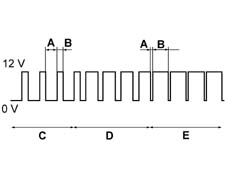
A, Off
B, On
C, Low resulting current
D, Medium resulting current
E, Maximum resulting current
FUEL SUPPLY SYSTEM
There are two distinct fuel systems present.
The petrol system is the returnless type with an electric fuel pump immersed in the tank and a casing which incorporates the voltage regulator, the fuel gauge and the filter.
The methane system has two cylinders connected in parallel, a pressure reduction unit and specific injectors located on the intake manifold (for further details see 'Description and operation - Subgroups 1040, 1042 and 1044').
MISFIRE
This occurs when the mixture (air/fuel) inside the combustion chamber fails to spark.
The effect gives rise to unneven running, which is particularly discernible when idling or at low speed.
Unburnt fuel emerges from the exhaust as a result and this impairs catalytic converter duration.
PWM PULSE WIDTH MODULATION
This is a fixed voltage with pulses of moduled amplitude and frequency generated by the ECU for the operation of the actuators. A supply with P.W.M. (Pulse Width Modulation) voltage consists of a series of square waves with single polarity, whose duration is varied by the ECU in response to demand.
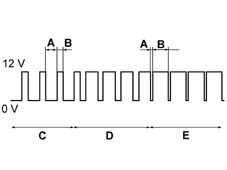
A, Off
B, On
C, Low resulting current
D, Medium resulting current
E, Maximum resulting current
EVAPORATION
A pulse width modulated current varies in proportion to the ratio between Wave and Space. The Wave-Space ratio is the relationship between periods when the power supply is on and periods when it is off. This ratio may be considered as a percentage, and this is the way the Duty Cycle is measured.
AIR SUPPLY SYSTEM
Air supply system with plastic inlet manifold and large air filter casing to limit inlet noise.
PWM PULSE WIDTH MODULATION
This is a fixed voltage with pulses of moduled amplitude and frequency generated by the ECU for the operation of the actuators. A supply with P.W.M. (Pulse Width Modulation) voltage consists of a series of square waves with single polarity, whose duration is varied by the ECU in response to demand.
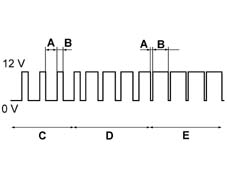
A, Off
B, On
C, Low resulting current
D, Medium resulting current
E, Maximum resulting current
PWM PULSE WIDTH MODULATION
This is a fixed voltage with pulses of moduled amplitude and frequency generated by the ECU for the operation of the actuators. A supply with P.W.M. (Power Width Modulation) voltage consists of a series of square waves with single polarity, whose duration is varied by the ECU in response to demand.
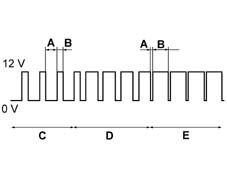
A, Off
B, On
C, Low resulting current
D, Medium resulting current
E, Maximum resulting current
PWM PULSE WIDTH MODULATION
A pulse width modulated current varies in proportion to the ratio between Wave and Space. The Wave-Space ratio is the relationship between periods when the power supply is on and periods when it is off. This ratio may be considered as a percentage, and this is the way the Duty Cycle is measured.
RESONANCE
Phenomenon in which the amplitude of oscillations induced in a vibrating system tends, under particular conditions, to become intensified (amplified) beyond all limits.
EXHAUST SYSTEM
The exhaust system is equipped with a system for post-treating exhaust gases with twin lambda probes, one upstream and one downstream of the catalytic converter fitted in the engine bay (for further details see 'Description and operation - Subgroup 1076').
PWM PULSE WIDTH MODULATION
A pulse width modulated current varies in proportion to the ratio between Wave and Space. The Wave-Space ratio is the relationship between periods when the power supply is on and periods when it is off.
This ratio may be considered as a percentage, and this is the way the Duty Cycle is measured.
Resonance
Phenomenon in which the amplitude of oscillations induced in a vibrating system tends, under particular conditions, to become intensified (amplified) beyond all limits.
SENSOR
This is a system which, stimulated by any form of energy, reacts by changing its state, hence one or more of its characteristics (resistivity, volume, temperature, etc.).
For example, a material which, immersed in a magnetic field, undergoes a change in its conductivity, is a sensor.
New-generation sensors are solid-state devices of microelectronic technology, which can read the environment and provide responses in the form of electrical signals for subsequent processing for final control actions.
They can measure forces, acceleration, pressures and temperatures of gases, liquids and solids, concentrations of gases such as nitric oxides, oxygen, etc.
EMISSION CONTROL SYSTEM
The following emission control systems are fitted on this model:
- Exhaust emission control system with a three-way catalytic converter and 2 Lambda sensors, one downstream and one upstream of the catalytic converter;
- crankcase vapour/gas recirculation system;
- fuel evaporation control system; (for further details see 'Description and operation - Subgroup 1080').
Wheel
This is a system which, stimulated by any form of energy, reacts by changing its state, hence one or more of its characteristics (resistivity, volume, temperature, etc.).
For example, a material which, immersed in a magnetic field, undergoes a change in its conductivity, is a sensor.
New-generation sensors are solid-state devices of microelectronic technology, which can read the environment and provide responses in the form of electrical signals for subsequent processing for final control actions.
They can measure forces, acceleration, pressures and temperatures of gases, liquids and solids, concentrations of gases such as nitric oxides, oxygen, etc.
Sensor
This is a system which, stimulated by any form of energy, reacts by changing its state, hence one or more of its characteristics (resistivity, volume, temperature, etc.).
For example, a material which, immersed in a magnetic field, undergoes a change in its conductivity, is a sensor.
New-generation sensors are solid-state devices of microelectronic technology, which can read the environment and provide responses in the form of electrical signals for subsequent processing for final control actions.
They can measure forces, acceleration, pressures and temperatures of gases, liquids and solids, concentrations of gases such as nitric oxides, oxygen, etc.
VISCOSITY
Property of matter whereby the particles of a body meet 'resistance' in sliding in relation to each other.
The value of the resistance or internal friction depends on the nature of the body, large in solids, very small in viscous liquids and non-existent in gases.
In liquids, viscosity decreases rapidly as temperature increases.
COOLING SYSTEM
Forced circulation with a centrifugal vane pump (for further details see 'Description and operation - Subgroup 1088').
Viscosity
Property of matter whereby the particles of a body meet 'resistance' in sliding in relation to each other.
The value of the resistance or internal friction depends on the nature of the body, i.e. large in solids, very small in viscous liquids and non-existent in gases.
In liquids, viscosity decreases rapidly as temperature increases.
Viscosity
Property of matter whereby the particles of a body meet 'resistance' in sliding in relation to each other.
The value of the resistance or internal friction depends on the nature of the body, large in solids, very small in viscous liquids and non-existent in gases.
In liquids, viscosity decreases rapidly as temperature increases.
Direct injection turbodiesel engine without precombustion chamber, 4 cylinders in line, 1910 c.c., two valves per cylinder, overhead camshaft, supercharged with turbocharger and intercooler, Bosch Common Rail EDC-15C electronic fuel injection system.
POWER - 74 KW (100CV) EC at 4000 rpm
TORQUE - 20 daNm (20,4 kgm) EC at 1500 rpm
CYLINDER ARRANGEMENT - 4 in line
BORE - 82 mm
STROKE - 90,4 mm
CAPACITY - 1910cc
CYLINDER HEAD - aluminium
CRANKCASE - cast iron
CRANKSHAFT - in ductile cast iron with 8 counterweights and 5 main bearings with torsional damper
TIMING SYSTEM - one overhead camshaft, 2 valves per cylinder
INJECTION SYSTEM - Bosch common rail Unijet
SUPERCHARGING SYSTEM - IHI RHF3 turbocharger with electronic wastegate and intercooler
EMISSION CONTROL DEVICES - oxidising catalytic converer, electric EGR
LUBRICATION - forced, with in-line gear pump
COOLING: liquid with forced circulation via a centrifugal pump and sealed circuit; Radiator and additional expansion tank.
The following systems are involved in engine operation:
- fuel system;
- air supply system;
- engine cooling system;
- exhaust system with catalytic converter;
- oil vapour recirculation system;
- E.G.R. exhaust gas recirculation system;
- electric/electronic system.
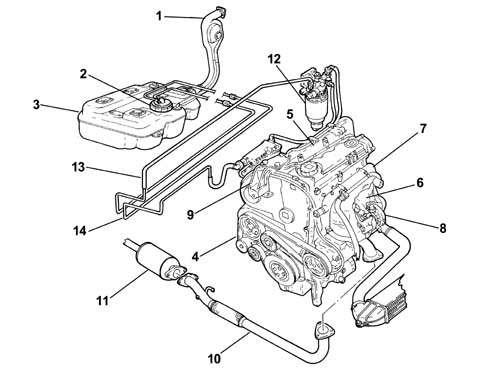
1, Fuel filler
2, Electric fuel pump
3, Fuel tank
4, Auxiliary drivebelt
5, Inlet manifold
6, Exhaust manifold
7, Cooling system pipes
8, Turbocharger
9, Power unit mounting
10, Exhaust pipe
11, Oxidizing catalyzer
12, Fuel filter
13, Fuel supply pipe
14, Fuel return pipe
Engine with 4 cylinders in line, 8 valves, 1242 cc., twin overhead camshaft with IAW 5EF electronic injection-ignition.
POWER - 65BHP EC (47.7 Kw) at 5500 rpm
TORQUE - 10.4 kgm EC at 3250 rpm
CYLINDER ARRANGEMENT - 4 in line
BORE - 70.8 mm
STROKE - 78.86 mm
CAPACITY - 1242 cc
CYLINDER HEAD - aluminium
CRANKCASE - cast iron
CRANKSHAFT - in ductile cast iron with 8 counterweights and 5 main bearings with torsional damper
TIMING SYSTEM - two overhead camshafts, mechanical tappets, 2 valves per cylinder
FUEL SYSTEM - returnless system with Marelli 5E F phased sequential injection, pintless Pico inejctors
IGNITION - fully electronic, inductive discharge with lost spark
EMISSION CONTROL DEVICES - trivalent catalytic converter with two lambda probes (EOBD)
LUBRICATION - forced via in-line trochoidal gear pump.
COOLING: liquid with forced circulation via a centrifugal pump and sealed circuit; Radiator and additional expansion tank.
Engine with 4 cylinders in line, 16 valves, 1596 cc, twin overhead camshaft with IAW 5NF integrated electronic injection/ignition system
BORE - 80.5 mm
STROKE - 78.4 mm
CAPACITY - 1596 cc
CYLINDER HEAD - aluminium
CRANKCASE - cast iron
CRANKSHAFT - in ductile cast iron with 8 counterweights and 5 main bearings with torsional damper
TIMING SYSTEM - two overhead camshafts, mechanical tappets, 2 valves per cylinder
FUEL SYSTEM - returnless system with Marelli 5NF phased sequential injection, pintless Pico inejctors
IGNITION - fully electronic, inductive discharge with lost spark
EMISSION CONTROL DEVICES - trivalent catalytic converter with two lambda probes (EOBD)
LUBRICATION - forced with gear pump
COOLING: liquid with forced circulation via a centrifugal pump and sealed circuit; Radiator and additional expansion tank.
It is a new I.D.I. (indirect diesel injection) naturally-aspirated engine which, for the 2230, is the confirmed version in the range of diesel engines.
A naturally-aspirated engine has been chosen in order to minimize fuel consumption (<> -0.7 l per 100 km on a mixed route); a larger cylinder capacity has been used to ensure one of the best performances in the category and excellent handling.
The main changes carried out on this engine amount to a new combustion system.
This high swirl combustion system uses a new combustion chamber to optimise fuel mixing with air and ensure more favourable operating conditions for reduced emissions and noise levels.
POWER: 63 BHP/46 kW 4500 rpm
TORQUE: 12 kgm/103 Nm 2250 rpm
CYLINDER ARRANGEMENT: 4 in line
BORE: 82 mm
STROKE: 90.4 mm
CAPACITY: 1910 cc
CYLINDER HEAD: in aluminium
CRANKCASE: cast iron
CRANKSHAFT: in ductile cast iron with 8 counterweights and 5 main bearings with torsional damper
TIMING GEAR: one overhead camshaft, 2 valves per cylinder
INJECTION SYSTEM: LUCAS EPIC, full electronic control
EMISSION CONTROL DEVICE: oxidising catalytic converter, EGR solenoid
LUBRICATION: forced with in-line gear pump
COOLING: liquid with forced circulation via a centrifugal pump and sealed circuit; - Radiator and additional expansion tank.
The following systems are involved in engine operation:
- fuel system;
- air supply system;
- cooling system;
- exhaust system with catalytic converter;
- oil vapour recirculation system;
- engine lubrication system;
- E.G.R. exhaust gas recirculation system;
- Electrical/Electronic system.
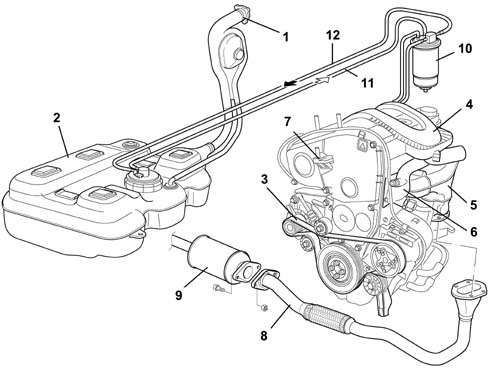
1, Fuel filler
2, Fuel tank
3, Auxiliary drive belt
4, Inlet manifold
5, Exhaust manifold
6, Cooling system pipes
7, Engine mounting
8, Exhaust pipe
9, Oxidising catalytic converter
10, Fuel filter
11, Fuel delivery line
12, Fuel return line
Technical advantages:
- Performance;
- high efficiency;
- reduced consumption, about 15% less compared with precombustion chamber;
- high reliability thanks to the adoption of a 'multilayer' metal cylinder head gasket;
- reduction of dispersed heat, so engine is technically less stressed;
- significant reduction of noise level;
- free choice of injection pressures;
- simplification of he pump operating mechanisms;
- improvements in air-fuel mixing with advantages in terms of emissions and consumption.
The following systems are involved in engine operation:
- fuel supply system
- air supply system;
- exhaust system with catalytic converter.
- fuel vapour recirculation system.
- lubrication system;
- engine cooling system
- The operation of these systems is optimized by an electronic control system governed by a control unit (see subunit 1056).
Engine operation is ensured by the following systems:
- fuel supply system
- air supply system;
- exhaust system with catalytic converter.
- fuel vapour recirculation system.
- lubrication system;
- engine cooling system
- The operation of these systems is optimized by an electronic control system governed by a control unit (see subunit 1056).
Technical advantages
The main technical advantages may be summarized as follows:
- reduced fuel consumption;
- significant reduction of noise level;
- improvements in air-fuel mixing with advantages in terms of emissions and consumption;
- improved idling;
- improved driveability;
- lower polluting emissions;
- high reliability thanks to the adoption of a 'MULTILAYER metal cylinder head gasket.
View of assembly
Vehicle system diagram
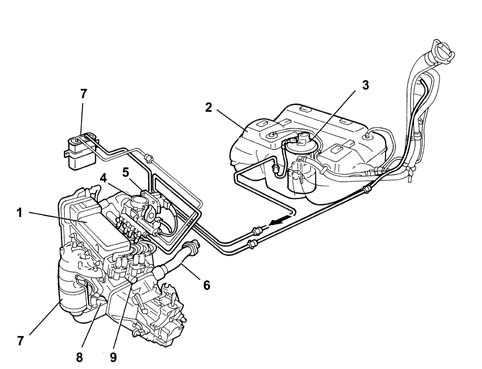
1, Engine and power unit
2, Fuel tank and pipes
3, Pump(s) and fuel circuit devices
4, Engine air supply circuit
5, Petrol injection system
6, Exhaust pipes and silencers
7, Emission control system (fuel vapours)
8, Engine lubrication system
9, Engine cooling system
General view
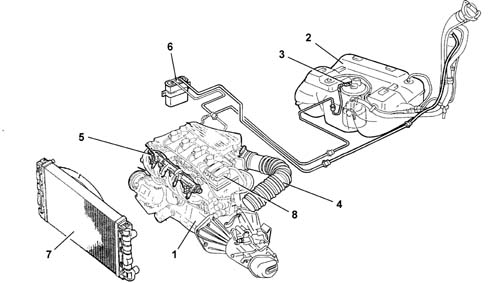
1, Engine and power unit
2, Fuel tank and pipes
3, Pump(s) and fuel circuit devices
4, Engine air supply circuit
5, Petrol injection system
6, Emission control system (petrol vapours)
7, Engine cooling
8, Electronic injection/ignition system
fuel supply system
It is the returnless type with an electric fuel pump immersed in the tank and a casing which incorporates the voltage regulator, the fuel gauge and the filter (for further details see 1040).
Fuel supply system
It is the returnless type with an electric fuel pump immersed in the tank and a casing which incorporates the voltage regulator, the fuel gauge and the filter (for further details see 1040).
Air supply system
Air supply system with plastic inlet manifold and large air filter casing to limit inlet noise (for further details see 1048 and 1072 ).
Air supply system
Air supply system with plastic inlet manifold and large air filter casing to limit inlet noise (for further details see 1048).
Exhaust system
The exhaust system is equipped with a system for post-treating exhaust gases with twin lambda probes, one upstream and one downstream of the catalytic converter fitted in the engine bay (for further details see 1076).
Emission control system;
The following emission control systems are fitted on this model:
- Exhaust emission control system with a three-way catalytic converter and twin Lambda probes;
- crankcase vapour/gas recirculation system;
- fuel evaporation control system;
(for further details see 1080).
Emission control system;
The following emission control systems are fitted on this model:
- Exhaust emission control system with a three-way catalytic converter and twin Lambda probes;
- crankcase vapour/gas recirculation system;
- fuel evaporation control system; (for further details see 1080).
Cooling system.
Forced circulation with a centrifugal vane pump (for further details see 1088).
Parts & tools for this job Staging For 2000 Fiat Doblò
- PARTEngine gasket setSearch: Fiat Doblò 2000 engine gasket set
- TOOLTorque wrenchSearch: 3/8 inch torque wrench
- TOOLFeeler gauge setSearch: feeler gauge set
Links open Amazon search results in a new tab. As an Amazon Associate I earn from qualifying purchases.