
Catalytic converter
- Make
- Lancia
- Model
- Thesis Factory Service Manual
- Year
- 2002–2009
- Section
- Emission control system › Catalytic converter
CATALYTIC CONVERTER
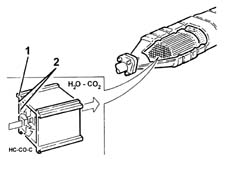
The catalytic converter is a post-treatment device for oxidizing the CO, HC and particles transforming them into carbon dioxide (CO2) and water vapour (H20).
The catalytic converter consists of a ceramic, honeycomb structure (1) with cells impregnated with platinum (2) which catalyzes the oxidation reactions.
The exhaust gases passing through the cells heat the catalyzer triggering off the conversion of the pollutants into inert compounds.
The oxidizing chemical reaction of the CO, HC and particles is effective at temperatures of between 200 and 350°C.
In effect, above 350°C the sulphur contained in the diesel fuel starts to oxidize producing sulphur dioxide and sulphur trioxide.
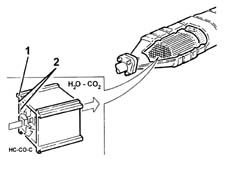
The catalytic converter is a post-treatment device for oxidizing the CO, HC and particles transforming them into carbon dioxide (CO2) and water vapour (H20).
The catalytic converter consists of a ceramic, honeycomb structure (1) with cells impregnated with platinum (2) which catalyzes the oxidation reactions.
The exhaust gases passing through the cells heat the catalyzer triggering off the conversion of the pollutants into inert compounds.
The oxidizing chemical reaction of the CO, HC and particles is effective at temperatures of between 200 and 350°C.
In effect, above 350°C the sulphur contained in the diesel fuel starts to oxidize producing sulphur dioxide and sulphur trioxide.
Parts & tools for this job Staging For 2002 Lancia Thesis
- PARTExhaust gasketSearch: Lancia Thesis 2002 exhaust gasket
- TOOLPenetrating oilSearch: penetrating oil
- TOOLOBD2 scannerSearch: OBD2 scanner
Links open Amazon search results in a new tab. As an Amazon Associate I earn from qualifying purchases.