
Exhaust gas recirculation system (e.g.r.)
- Make
- Lancia
- Model
- Ypsilon Factory Service Manual
- Year
- 2003–2011
- Section
- Exhaust emission control system › Exhaust gas recirculation system (e.g.r.)
Exhaust gas recirculation system (e.g.r.)
This system directs a proportion of exhaust gases (5 - 15%) to the intake under certain service conditions.
This lowers the temperature peak in the combustion chamber to reduce the formation of nitrogen oxides (NOx).
The E.G.R. valve (1) is controlled by the fuel injection control unit (2), and carries out the function of re-injecting into the engine intake some of the exhaust gases drawn from the exhaust manifold (4).
A heat exchanger (3) allows the partial cooling of the exhaust gases, further lowering the temperature in the combustion chamber.
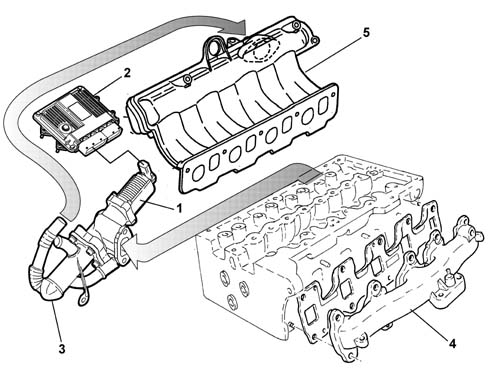
1 - E.G.R. valve
2 - Fuel injection control unit
3 - Heat exchanger
4 - Exhaust manifold
5 - Air inlet manifold
The fuel injection control unit, with coolant temperature > 20°C and engine speed of between 800 and 3000 rpm, drives the E.G.R. solenoid with a square-wave signal.
The change in this signal allows the EGR coil to move a plunger and thus adjust the flow of burnt gases from the exhaust manifold to the intake manifold; two results are thus obtained:
- less air is introduced;
- combustion temperature is reduced (due to the presence of inert gases) to reduce NOx (nitrogen oxide) production.
The engine control unit is kept constantly informed of recirculated gas quantity by information from the flow meter. If the intake of a certain amount of air (Qam) rpm is required at a certain rpm and the amount sent by the flow meter (Qar) is less, the difference (Qgr) is the recirculated gas quantity.
Qam - Qar = Qgr
Qam - Theoretical air quantity in memory
Qar - True air quantity
Qgr - Recirculated gas quantity
The atmospheric pressure signal is used when controllling the EGR valve to recognize when the car is driving at altitude and so reduce the quantity of recirculated gas and prevent the engine from producing fumes.
E.G.R. SOLENOID VALVE
The Pierburg EGR valve fitted on the cylinder head modulates the flow of exhaust gas to the intake according to a command received from the injection control unit.
Modulation takes place via an internal solenoid controlled in PWM by the control unit, which operates the control rod from the internal valve which, when oopen, conveys the gases into the inlet manifold.
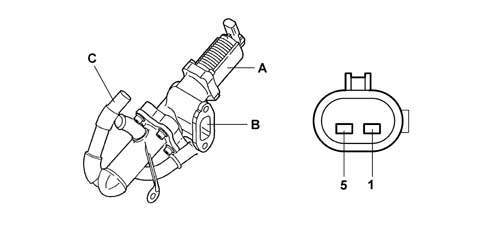
A - E.G.R. valve body
B - Gas inlet from exhaust manifold
C - Gas outlet to inlet manifold
1 - Solenoid positive
5 - Solenoid negative
Parts & tools for this job Staging For 2003 Lancia Ypsilon
- PARTExhaust gasketSearch: Lancia Ypsilon 2003 exhaust gasket
- TOOLPenetrating oilSearch: penetrating oil
- TOOLOBD2 scannerSearch: OBD2 scanner
Links open Amazon search results in a new tab. As an Amazon Associate I earn from qualifying purchases.