
Transmission
- Make
- Fiat
- Model
- Panda Factory Service Manual
- Year
- 2003–2012
- Section
- General › Transmission
TRANSMISSION
Introduction
The four wheel drive on the Panda uses two differentials and a viscous coupling. It is a permanent four wheel drive that does not require any manoeuvre by the driver but allows the optimum distribution of the drive torque between the front and rear axles depending on the road surface grip conditions.When driving in normal grip conditions (dry asphalt, etc.) around 99% of the drive torque is directed to the front wheels allowing the vehicle to behave like a vehicle with front wheel drive and thereby also avoiding excessive wear of the tyres and fuel consumption due to the slight differences in rotation speed between the front and rear wheels. When driving in poor grip conditions (snow on the road, icy, muddy, etc.) the front drive wheels tend to slip but the viscous coupling immediately corrects this tendency "becoming rigid" and gradually transmitting an increasing percentage of the drive torque rising to 100% and up to a maximum of about 850 Nm to the rear end cancelling out the slipping and ensuring the optimum distribution of the drive between the four wheels. This transfer of torque is not noticeable to the driver except in terms of the excellent release capacity of the vehicle.
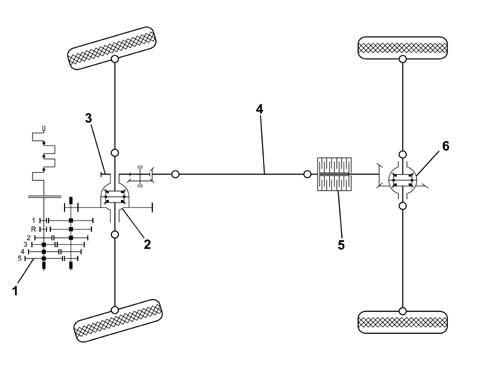
- 1 C514R M.T. gearbox
- 2 Front differential
- 3 Drive
- 4 Propeller shaft (in two pieces)
- 5 Viscous coupling
- 6 Rear differential
Drive torque and grip
A pair of forces act on a vehicle''s drive wheels (figure A), which lead to S (drive or propulsion force) and St (tangential drive force), in the same measure, whose value is determined by the ratio between the drive force Mt applied to the drive wheels and the radius r of the actual wheels:S = St = Mt / r
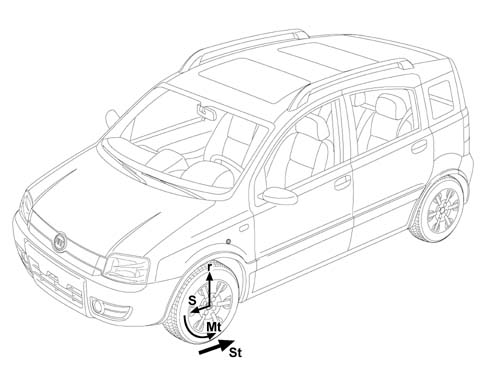
- Figure A
In order for a vehicle to move (figure B) (take off from stationary) or accelerate, the drive force S must be greater than the total resistance of the advancement R and less than the adherence. More precisely, the tangential force St which is of the same intensity as the drive force S, must be less than the value of the available adherence A.
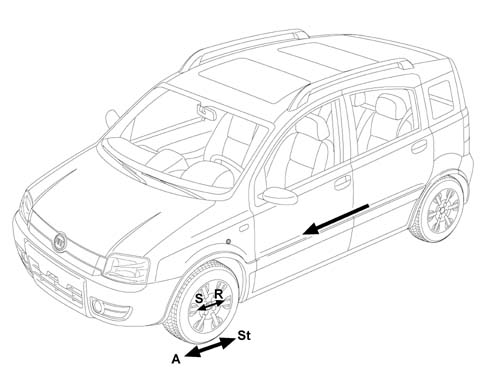
- Figure B
In conditions of equilibrium, the advancement of the vehicle at an even speed is ensured when the force S is equal to the resistance R.The value of the total resistance to the advancement R is deteremined by the sum of the resistances due to rolling, air penetration, inertia of the means and gradients.The value of the available adherence A is determined by the product of the friction coefficient "µ" in force between the bodies in contact (in this case the tyre and the ground) for the weight "P" of the vehicle acting on the wheel: A = µ*PSince the weight P weighing on the tyre is a constant like the friction coefficient "µ", the adherence available A can be represented in a circular diagram in relation to the point of contact between the tyre and the ground (figure C). The adherence is available in all directions, therefore on both the longitudinal axis of the tyre on which the traction force S and the tangential force St are acting and on the transverse axis on which external disturbing forces Fe (side wind) and/or centrifugal forces Fc (vehicle cornering) are acting. When the intensity of an external force (driving or disturbing) reaches the value of the adherence A this is no longer available in any other direction.
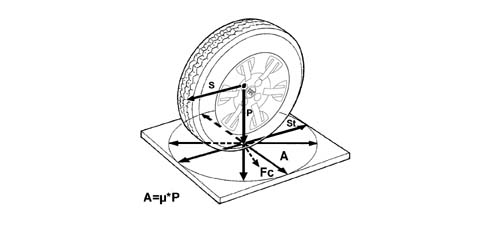
- Figure C
When the tangential drive force St applied is greater than the adherence available A (snow, ice, mud) the drive wheels tend to slip and the vehicle does not move when setting off from a standstill (figure D).
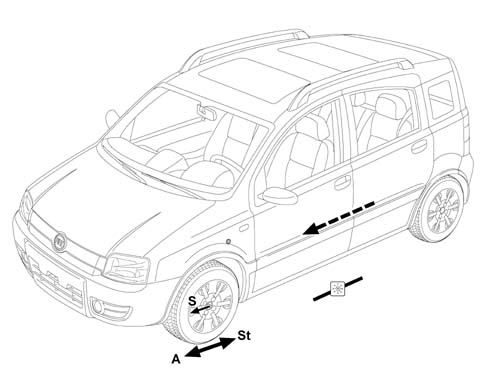
- Figure D
Like the drive torque supplied by the engine, distribution to four wheels rather than two (S1 and S2) reduces the value of the tangential drive forces St1 and St2 applied to each drive wheel (figure E).
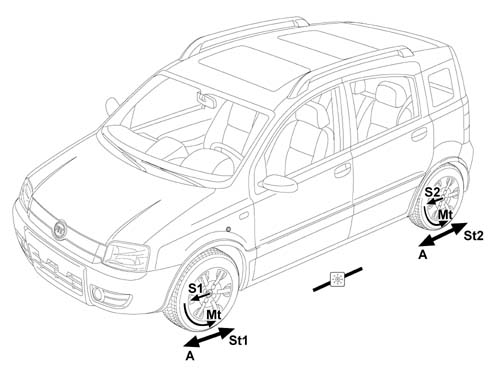
- Figure E
As the drive torque for each of these has been decreased, the fraction of available adhesion A increases as a result before the wheel starts to slip.Four wheel drive means that four drive wheels are available with the advantage of sharing the drive torque between four wheels instead of two.This is useful in all situations where increased torque is required to overcome uneven surfaces or unmade roads or when the grip conditions are poor and only two drive wheels may not be sufficient to propel the vehicle: snow, ice, mud, sand, etc.
Four wheel drive
In addition to advantages in terms of drive (full use of the available torque) four wheel drive offers further fundamental advantages in terms of safety, stability and even handling of the vehicle.Safety: is improved because any lack of grip for the drive wheels due to irregularities in the road (acqua planing, icy patches, oil slicks) is compensated for and balanced out by the other drive wheels.Stability: this is increased because there is a greater directional reserve due to a decreased drive commitment. On a vehicle with two drive wheels taking a bend (figure F) for reasons of simplicity force S is considered rather than St of the same intensity. Drive force S totally commits the available adherence range represented by the circle; the centrifugal force Fc produces a resulting T which falls outside the circle: the vehicle loses its direction and consequently its stability
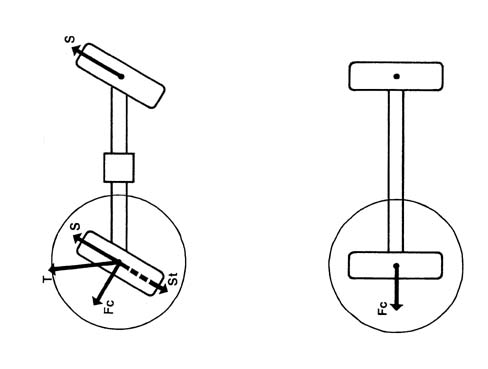
- Figure F
The rear wheels are barely exploited because the acting Fc1 (figure G) leaves adherence available that can be used for drive purposes. On a vehicle with four drive wheels with the same drive torque supplied by the engine it is possible to transmit greater drive torques to the ground using the rear wheels as well. In limited grip conditions, where the difference in revs between the front and rear varies, there is a distribution to the rear, decreasing the grip force at the front S1 and redistributing it between the four wheels.
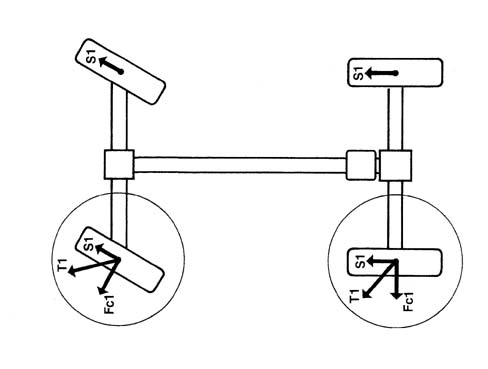
Permanent four wheel drive
A vehicle with permanent four wheel drive has four drive wheels permanently engaged. Permanent four wheel drive is achieved by means of a force applied to the front differential crown wheel, an idler, a centre differential and a coupling (which can be viscous or mechanical) with the task of permanently modulating the front and rear wheel drive and a rear differential integrated in a rear axle.Vehicles with permanent four wheel drive can be divided into:
- Vehicles with the drive constantly distributed between the axles: a centre differential distributes the drive to the front and to the rear constantly (for example, the Lancia Delta 4x4 where the epicyclic centre differential distributes 56% of the drive to the front and 44% to the rear)
- Vehicles with the drive distributed in a variable manner: these vehicles are usually equipped with a viscous coupling which modulates the percentage of drive shared between the front and the rear (e.g. the Fiat Panda 4x4).
Four wheel drive that can be switched on
Four wheel drive that can be switched on allows the user to control the four wheel drive engagement directly, as and when needed (poor grip, steep hills) on vehicles that normally drive on two drive wheels. These vehicles are usually equipped with a drive from the gearbox or from the differential, a propeller shaft which normally freewheels, a rear differential and a drive engagement mechanism. This mechanism can be a clutch, a splined sleeve or a front toothed drive that can be switched on either manually or automatically.The use of four wheel drive that can be engaged is advisable for poor grip conditions (snow, ice) or steep hills; compared with vehicles with two wheel drive it offers practical advantages in terms of performance and disengagement.
Transmission of power
On the current Panda 4x4 version the drive coming from the gearbox layshaft (1) passes through the front differential (3) ring gear (2) and reaches the front wheels.At the same time, by means of the drive (4), the idler unit (5), the propeller shaft (6), the viscous coupling (7) the power arrives via the rear differential unit (8) and the oscillating driveshafts (9) at the rear wheels.
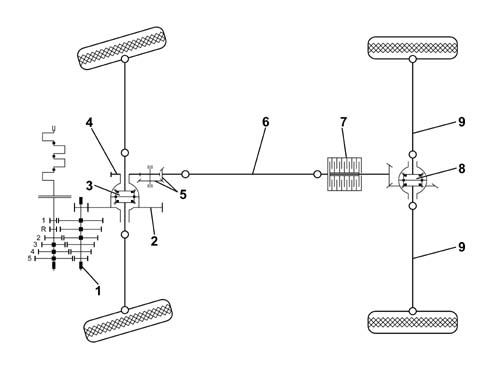
- 1 Layshaft
- 2 Ring gear
- 3 Front differential
- 4 Drive
- 5 Idler unit
- 6 Propeller shaft (in two pieces)
- 7 Viscous coupling
- 8 Rear differential
- 9 Driveshafts
Drive and idler unit
The drive consists of a pinion (1) that meshes with the front differential ring gear (2).The idler unit consists of a pair of conical gears (3) connected to the drive (1) and to the propeller shaft, respectively, by means of a flange connection (4).The drive and the idler unit are housed in a new differential half casing matched with the original gearbox casing.Any irregularities in one of the casing components (bellhousing, centre casing, half casing with drive and idler unit) means that the complete gearbox casing has to be replaced.The drive and the idler unit are lubricated by the same transmission fluid as the gearbox.
If the differential ring gear is being replaced, only use the specific replacement part for the 4x4 version.
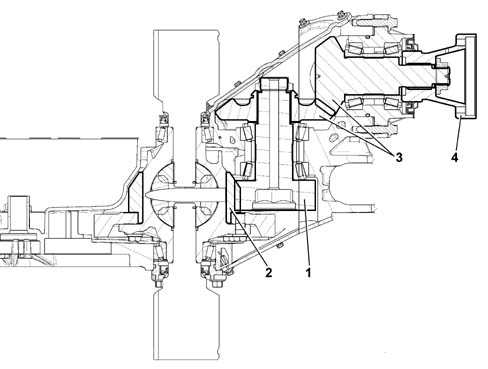
- 1 Pinion
- 2 Ring gear
- 3 Conical gears
- 4 Flange
Propeller shaft
The propeller shaft is divided into two sections.The front section (1) is connected to the idler unit on one side and to the rear section (6) on the other by means of universal joints (2) and is supported by a bearing (3) protected by a flexible mounting (4) and is fastened to the bodyshell by a bracket (5).The rear section (6) is connected to the front section on one side by universal joints and to the viscous coupling on the other side.
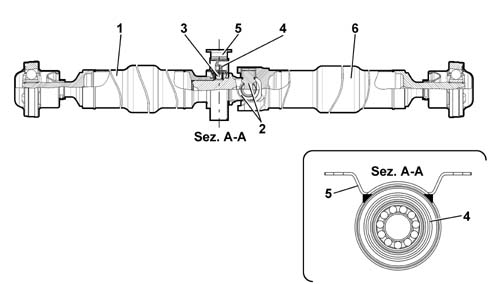
- 1 Front section
- 2 Universal joints
- 3 Bearing
- 4 Flexible mounting
- 5 Bracket
- 6 Rear section
Viscous coupling
The viscous coupling connects the propeller shaft to the rear differential pinion leaving them free to slide slightly so that they can rotate at slightly different speeds. The viscous coupling, also known as a Ferguson coupling, comprises a casing filled with a special silicon liquid that gradually becomes denser as its temperature increases.This property is used to limit and, ultimately, prevent, the reciprocal slipping between two sets of metal discs that are opposite each other very slightly apart and are connected, one to the propeller shaft and one to the rear differential pinion. When the slipping is over, the temperature of the silicon liquid decreases and so does its density, returning to normal conditions and allowing small movements between the shafts once again.
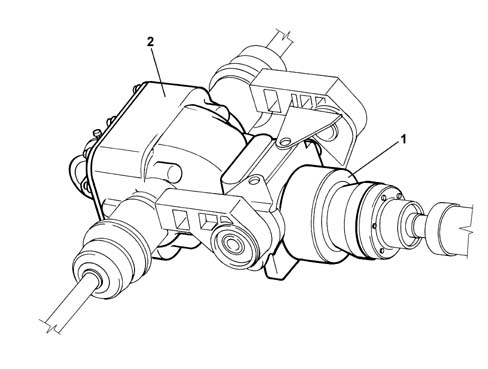
- 1 Viscous coupling
- 2 Rear differential
Operation
The viscous coupling "works" each time a difference in speed between the two main components is created (between the two sets of metal discs); the faster part drives the slower part until the equilibrium between the two parts rotating at the same speed is restored. - The torque varies as the difference in speed between the parts varies. The greater the difference in speed, the greater the torque transmitted (figure G).Whilst driving on a road in a normal vehicle with two drive wheels, the rear wheels are driven by the front ones and constrained to rotate at a speed dependent on their rolling radius. - Whilst driving on a road in a Panda 4x4 the rear wheels and the different ratio for the rear axle causes the rotation of the inner part of the viscous coupling at a slightly higher speed that the outer part caused to rotate by the engine by means of the PTU ratio. This creates the difference in speed required for the distribution of the torque. It can be stated that the Panda 4x4 has a permanent four wheel drive system. - The torque which is transferred to the front wheels depends on all the various factors that can affect the reciprocal rotation speed between the front and rear wheels (tyre wear, variation in load between the front and the rear, driving uphill or downhill, slipping of the front end on account of snow or ice).
Towing the vehicle with only the front wheels raised off the ground unable to rotate may lead to damage of the coupling and/or wear of the tyres.
The torque that can be transmitted by the viscous coupling to the rear axle can vary between 0 and 100% of the drive torque up to a maximum of around 850 Nm.Considering the vehicle on a flat road, from a theoretical calculation the value of the torque transmitted to the rear is around 0.3%.ni = no: no torque is transferred to the rearni > no: torque is transferred to the rearni >> no: a lot of torque is transferred to the rear
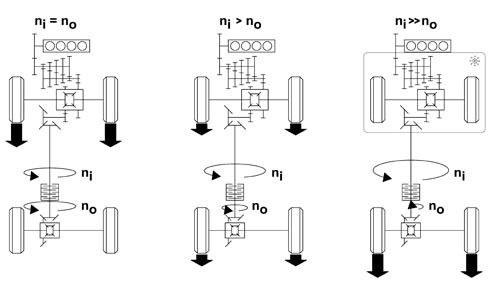
- Figure G
- ni: viscous coupling input revs
- no: viscous coupling output revs
The slipping of the front wheels produces an increase in the rotation speed of the propeller shaft and consequently the outer casing of the viscous coupling. The difference in rotation between the outer casing and the rear differential pinion (and the two sets of metal discs) creates an increase in the temperature and viscosity of the silicon fluid inside the viscous coupling. This cancels out the rotation between the metal discs and causes the transmission of the drive to the rear differential producing a distribution of the drive between the front wheels and the rear wheels.
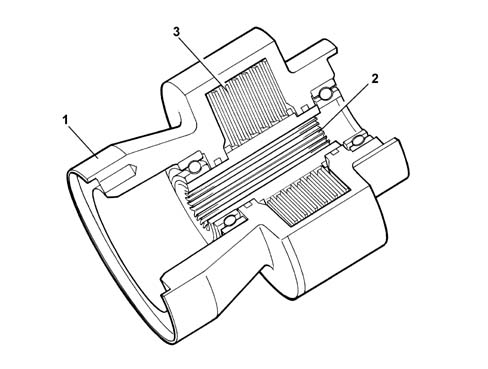
- 1 Viscous coupling outer casing (flanged to the propeller shaft)
- 2 Splined shaft (for connecting the rear differential pinion)
- 3 Set of metal discs
When the front wheels stop slipping and the speed of the propeller shaft decreases, the temperature of the silicon liquid decreases, its viscosity decreases and there is a consequent reduction in the transmission of the drive to the rear differential.
Rear differential
The rear differential unit comprises a pinion (1) meshing with the ring gear (2) fastened to the differential unit (3). The satellite gears (5) which mesh with the planet gears (6), in turn secured to the couplings (7), are secured to the bearing (4) on the differential unit.
The pinion (1) receives the drive torque transmitted from the propeller shaft from the viscous coupling (8).
The drive torque is shared equally between each of the wheels; if one wheel is on a slippery surface, the poor grip is minimized; in these conditions, the differential causes the slipping of the wheel that is rotating quickly and, at the same time, reduces the torque transmitted to the other one. In extreme conditions, if a wheel is not gripping at all, the differential will transmit no torque to the other wheel which will remain still affecting the forward movement of the vehicle.
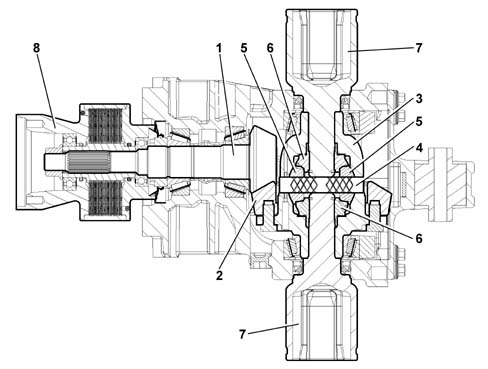
- 1 Pinion
- 2 Ring gear
- 3 Differential unit
- 4 Pin
- 5 Satellite gears
- 6 Planet gears
- 7 Couplings
- 8 Viscous coupling
Deceleration anti-slip system (MSR)
The Panda 4x4 is equipped with a deceleration anti-slip system that takes advantage of the ABS system potential (wheel rpm sensors) and the electronic control of the engine to prevent the engine braking torque and the presence of the viscous coupling causing the rear end to lock during sudden deceleration in poor grip conditions downhill or round bends. This system, together with the four wheel drive, guarantees extremely good safety on surfaces with poor and very poor grip conditions.
Parts & tools for this job Staging For 2003 Fiat Panda
- TOOLTorque wrenchSearch: 3/8 inch torque wrench
- TOOLSocket setSearch: socket set metric
- BOOKHaynes manualSearch: Haynes manual Fiat Panda
Links open Amazon search results in a new tab. As an Amazon Associate I earn from qualifying purchases.