
Battery
- Make
- Alfa Romeo
- Model
- 147 Factory Service Manual
- Year
- 2000–2002
- Section
- Current generation lighting › Battery
BATTERY
The current generation system consists of:
- the alternator;
- the battery;
- the recharging warning light in the instrument panel;
- the ignition switch for the system connections.
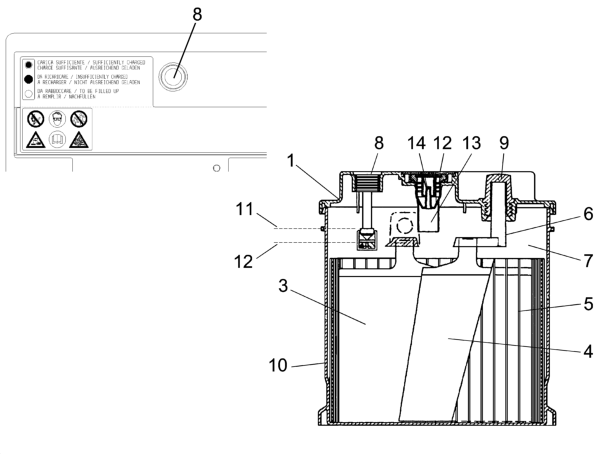
- 1 Cover
- 2 Cap edge
- 3 Positive plate
- 4 Negative plate
- 5 Separator
- 6 Bridges
- 7 Electrolyte
- 8 Water gauge
- 9 Negative pole
- 10 Monobloc
- 11 Maximum electrolyte level
- 12 Minimum electrolyte level
- 13 Cap
The main features of batteries used on new models are the mounting plates made from active materials produced through the calcium lead production technology which has replaced the older antimony- lead type.
This involves a mechanical stretching process for a continuous lead band to reach the final productio of a grille covered in lead oxides for the positive poles and metallic lead only for the negative poles, instead of the use of casting machines to
produce grilles for fusion.
The use of a material such as lead-calcium-tin alloy guarantees a considerable reduction in the electrolysis during the operation of the accumulator (dissociation of the water into its components of hydrogen and oxygen) where the gases can escape
resulting in reduced evaporation of the actual water with a drastic reduction in the maintenance required for this type of battery.
Battery electrical specifications:
- Lead accumulator, low maintenance type.
- Cover: EURODIN with ramp type sealing elements on cover; press-fit caps (one cap per element) with protection system against fluid penetration from the outside. Gas evacuation through caps with gas/liquid separation system
- Cover seal: heat welding.
- Attachment to the base: joined on four sides.
- Poles: lead bushes produced through cold-pressing with sealing labyrinth in the press-work area on the cover.
- Electrolyte level check: through the openings in the caps in the cover, checking the consistency between the indicator (dipstick) and the electrolyte level. The dipstick indicates the max. level allowed, therefore the electrolyte should just come
into contact with the lower end of the dipstick. The min. level is reached when the electrolyte exceeds the top end of the separators and/or plates by 10 mm.
- Water gauge for checking min. electrolyte level and battery charge.
- No. of plates: 6 positive + 5 negative.
- Alloy grille: lead-calcium-tin.
- Separator thickness: 1.15 mm.
- Plate thickness: positive 1.80 mm; negative 1.60
- Electrolyte density: 1280 ± 10 g/dm3 at 25°C with battery 100% charged.
Electrolyte density at 25° Celsius:
- 1280 g/litre 100 % of charge
- 1240 g/litre 75 % of charge
- 1200 g/litre 50 % of charge
- 1160 g/litre 25 % of charge
- 1120 g/litre drained
- 1110 g/litre totally drained.
Parts & tools for this job Staging For 2000 Alfa Romeo 147
- TOOLBattery testerSearch: car battery tester
- TOOLDigital multimeterSearch: automotive digital multimeter
- TOOLBattery terminal cleanerSearch: battery terminal cleaner
Links open Amazon search results in a new tab. As an Amazon Associate I earn from qualifying purchases.