
Sound insulation
- Make
- Alfa Romeo
- Model
- 156 Factory Service Manual
- Year
- 1997–2002
- Section
- General › Sound insulation
SOUND INSULATION
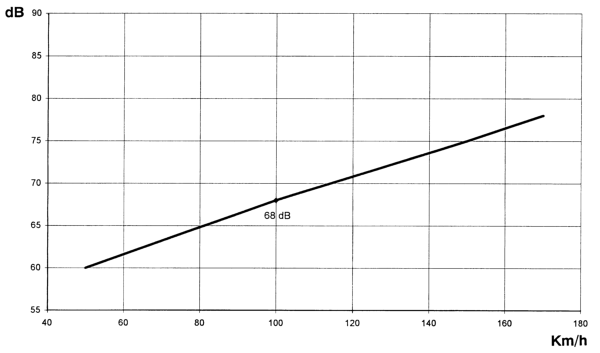
In order to meet the EEC regulations the design of the Alfa 156 has produced exterior noise levels of below 74 decibels, whilst inside the passenger compartment, at an average speed of 100 km/h in fifth gear, a noise level equal to 68 decibels has
been reached.
The improvement of driving comfort, in terms of quietness and liveability of the passenger compartment, has been achieved mainly by insulating the noise transmitted from the road surface, on the mechanics, on the assembly of the parts and on the
aerodynamics.
All engine types fitted to the Alfa 156 belong to a new generation with high technological content designed also to improve the acoustic/vibrational aspects.
This same principle also applies to the power transmission components, the suspension and the mountings on the bodyshell.
The low aerodynamic noise level is also safeguarded by the shape of the vehicle and the care taken over the components which, with their inevitable profiles, often adversely affect acoustic comfort, such as door handles, external rear view mirrors,
bumpers, various profiles.
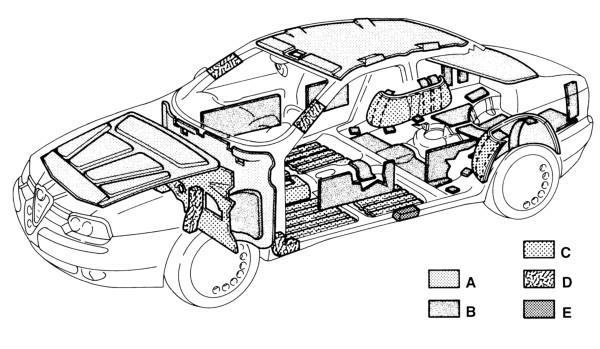
- A - Sound-insulating materials
- B - Soundproofing materials
- C - Sound-deadening materials
- D - Heat expandible materials
- E - URL preformed blocks
The following are the most effective measures taken to achieve an optimum level of sound insulation:
- insertion of preformed synthetic blocks (URL) in the longitudinal member box sections, to prevent transmission of vibrations to the car interior;
- special plugs have been inserted in the struts, the windscreen pillars and the rearscreen pillars; being made from a thermo-expandable material, they increase in volume during the bodyshell cataphoresis processes by around ten times thereby
completely filling the box section;
- optimizing the bodyshell with the careful design of all components subject to noise, where the rigidity has been increased and the fixings have been reinforced. Very careful attention has also been given to choosing materials in contact;
- sound insulation linings for the panels with thermo-bonding materials applied before painting;
- sound-deadening linings for the front of the dashboard, the front and rear running boards, the wheel housings in the luggage compartment and the side panels in the luggage compartment with pre-formed, composite panels;
- an extremely thick sound-deadening lining for the roof panel which is glued to improve the sound insulation properties;
- the use in the openings for passing the cables between the engine and passenger compartments on both the panels and the sound insulation material of double rubber seals with a thickness of - 5 mm, to reduce the transmission of noise from the engine
compartment to the passenger compartment;
- a thorough check of the sealants.
To maintain the high level of acoustic comfort reached, in the case of repairs, the solutions adopted during construction must be restored exactly.
Parts & tools for this job Staging For 1997 Alfa Romeo 156
- TOOLTrim removal tool kitSearch: trim removal tool kit
- PARTTouch-up paintSearch: Alfa Romeo touch up paint
- PARTPanel clip assortmentSearch: Alfa Romeo panel clips assortment
Links open Amazon search results in a new tab. As an Amazon Associate I earn from qualifying purchases.