
Recyclability of materials
- Make
- Alfa Romeo
- Model
- 156 Factory Service Manual
- Year
- 1997–2002
- Section
- General › Recyclability of materials
RECYCLABILITY OF MATERIALS
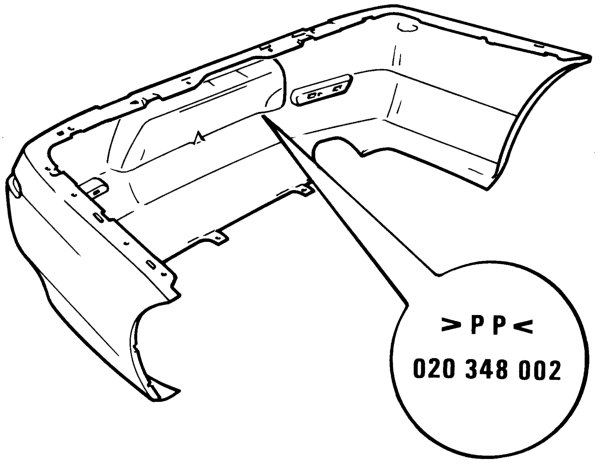
Currently, when the vehicle reaches the 'end of its life' only the metal parts are recovered and reused to produce new steel and new aluminium castings.
All of the remaining part of the vehicle, which corresponds to about 25% in weight, is abandoned or eliminated.
An enormous amount of material and energy is therefore wasted in addition to contributing to increasing the size of the problem of disposing of solid waste.
The problem of recycling plastic materials can be solved from the design. During this stage it is necessary to evaluate the possibility of reusing the material in future components.
This model has been designed so that all the plastic and rubber components weighing more than 50 grams are marked with coded symbols which identify the material for recycling and therefore all the components can be recycled.
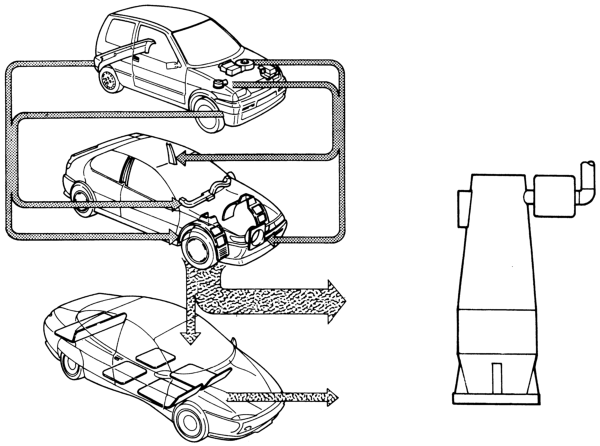
Recycling does not allow the same component to be produced as the starting one because the necessary properties of reliability cannot be guaranteed or it may not be suitable.
Insulating materials for building are obtained from seat upholstery.
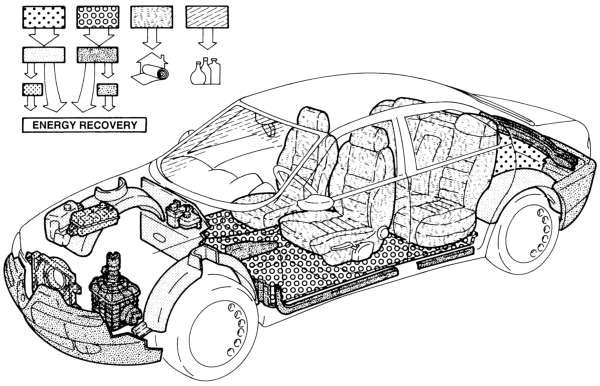
For other plastic materials, the recycling is carried out as follows: for example, the material for wheel arch liners which comes from the bumpers is then used in the next stage for producing sound insulation linings and finally ends up as fuel for
the production of energy.
Recycling therefore involves three successive generations of vehicles, contributing to savings in raw materials.
The tables, in the chapter on product Descriptions and Specifications, show the symbols and the names of the recyclable materials on the vehicle. This is because in service situations the suitable products are selected and used for internal washing,
painting plastic materials, repairs, bonding, etc.
The aim is to avoid possible damage with product which are not compatible with one another.
In addition, marking makes it possible to select organic materials on the basis of their chemical composition.
It is also advisable, in a service situation, to separate materials on the basis of their composition in order to be able to send them off more easily for recycling.
Parts & tools for this job Staging For 1997 Alfa Romeo 156
- TOOLTrim removal tool kitSearch: trim removal tool kit
- PARTTouch-up paintSearch: Alfa Romeo touch up paint
- PARTPanel clip assortmentSearch: Alfa Romeo panel clips assortment
Links open Amazon search results in a new tab. As an Amazon Associate I earn from qualifying purchases.