Running gearAssessing degree of wear on ceramic brake discs
| Assessing degree of wear on ceramic brake discs |

Note | Ceramic brake discs are installed on the front axle only. |
| Checking area of bolted connection on friction ring and brake disc hub: |

WARNING | The brake disc ring and the brake disc hub are bolted together and must NOT be separated. Do NOT slacken the bolted connection on the brake disc hub. |
|
| Designation of ceramic brake disc on brake disc hub |
|
|
|
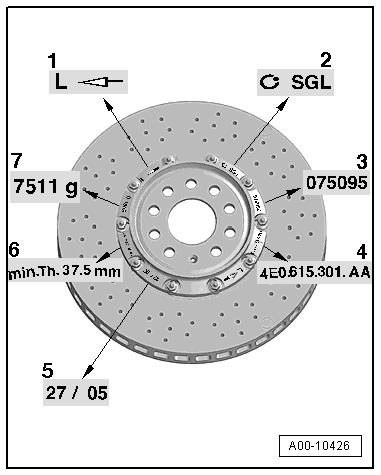
| 1 - | Direction of rotation |
| 3 - | Serial production number of brake disc |
Note
| The Audi part number of the brake disc is an example and can vary depending on the vehicle type and model |
| 5 - | Production date of brake disc |
| 6 - | Permissible minimum thickness of brake disc |
Note
| The minimum permissible thickness of the brake disc differs depending on the type of vehicle. |
| 7 - | Weight of new brake disc with brake disc hub |
| Checking area of bolted connection on friction ring and brake disc hub: |
WARNING | The brake disc ring and the brake disc hub are bolted together and must NOT be separated. Do NOT slacken the bolted connection on the brake disc hub. |
|
Note
| The weight of the new brake disc with hub differs depending on the type of vehicle. |
| The brake disc must first be cleaned before assessing the degree of wear as described below. |
WARNING | Do NOT clean the brake disc with water or other fluids as this will falsify the results. |
|

Caution | Always observe respiratory protection requirements when cleaning brake discs or other parts of the brake system using compressed air. |
|
Note | t
| The brake disc vent holes must be completely free of brake dust and dirt. Clear out carefully with a suitable tool if necessary. Do not use force. |
| t
| Thoroughly blow out the brake discs with compressed air (including the area between the cooling channels and vent holes). |
Caution | Always observe respiratory protection requirements when cleaning brake discs or other parts of the brake system using compressed air. |
|
| To assess the brake disc wear, proceed as follows: |
| t
| 1. Wear assessment by checking thickness of brake disc |
| t
| 2. Wear assessment on basis of wear indicators |
|
|
|
| 1. Wear assessment by checking thickness of brake disc → Chapter |
| Thickness of brake discs in permissible range → brake disc OK |
| Brake disc thickness in critical range min. Th + 0.2 mm | Value at or below limit |
| ↓↓ | ↓↓ |
| Further wear assessment on basis of wear indicators | Renew brake disc |
| ↓↓ | ---------- |
| 3. Wear assessment on basis of wear indicators → Chapter |
| None of the six wear indicators fully worn out → brake disc OK |
| ---------- | One of the six wear indicators fully worn out |
| --------- | ↓↓ |
| ---------- | Renew brake disc |
| Always renew brake discs on both sides of axle if: |
| t
| the brake discs have to be renewed because of wear. |
| t
| there has been a technical modification to the replacement brake disc (indicated by changed part number). |
| If one of the three wear limits defined below has been reached, do NOT continue using the brake disc. The brake disc must be renewed. |
| In this case, always renew the brake discs on both sides of the axle. |
| When doing so, always renew the brake pads on both sides of the axle. |
|
|
|
01 Steering & suspension
